


Open Your Eyes by Following the Sounds
I’VE SAID MANY TIMES in this blog that soundwalking is a superb way to explore a place, especially a place as rich and diverse as Paris. Whilst ‘pure’ soundwalking involves concentrated listening to the exclusion of almost everything else, a soundwalk can also be the key to a wider exploration of a place especially if you use your curiosity to follow the sounds and see where they lead. Over the last few days I’ve been soundwalking along the Boulevard Barbès and the surrounding area in the 18th arrondissement. This is a part of Paris well off the tourist track and a part of the city that I find endlessly fascinating. In this post I will show how even a fairly short soundwalk, in this case a walk along part of the Boulevard Barbès, can lead to discovering things that may be hidden, but if you follow the sounds and engage your curiosity the hidden can often emerge into plain sight.
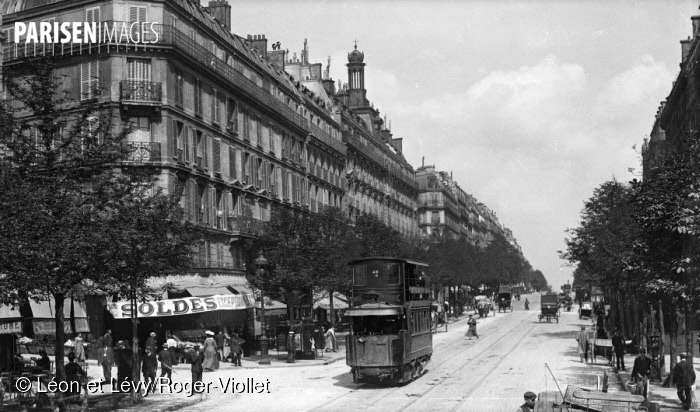
Boulevard Barbès. Paris (XVIIIth arrondissement), circa 1900. © Léon et Lévy/Roger-Viollet: Image courtesy of Paris en Images
A soundwalk along part of the Boulevard Barbès:
Named after the French Republican revolutionary Armand Barbès, the Boulevard Barbès is a product of Baron Haussmann’s transformation of Paris in the mid-nineteenth century. Once home to the sumptuous Grands Magasins Dufayel, which, on the eve of the First World War advertised itself as being the largest department store in the world, the grands magasins elegance of the Boulevard Barbès has now faded. Today, the Grands Magasins Dufayel, originally known as Le Palais de la Nouveauté until the ambitious Georges Dufayel took it over in 1888 and named it after himself, is occupied by the BNP bank and a good part of the street is filled with small shops selling mobile phones, jewelry, luggage, clothes and shoes all at bargain prices.

The former Grands Magasins Dufayel from Boulevard Barbès

The entrance to the former Grands Magasins Dufayel in Rue Clignancourt
Even if the Boulevard Barbès has gone somewhat down market since the grandeur of La Belle Époque it is still not without interest.
Crossing the bottom of the street between what is now the TATI store on one side and the Brasserie Barbès on the other once ran the Barricade rue du Faubourg Poissonnière, one of the most imposing and one of the last barricades to fall during the 1848 Revolution, which ended the Orléans monarchy (1830–1848) and led to the creation of the French Second Republic.

Site of the 1848 Barricade rue du Faubourg Poissonnière
Also of interest is N° 10 Boulevard Barbès.
This was once the Bal du Grand Turc, founded in 1806 by Joseph Teiche and frequented by Alexander Dumas père and Emile Zola amongst others. Emile Zola refers to the Bal du Grand Turc in his novel L’Assomoir. It then became the Concert de la Fourmi, one of several café-concerts in the area. Maurice Chevalier performed here in 1902, early in his professional career.

N° 10 Boulevard Barbès, Café-concert La Fourmi, around 1905: Image via Lagouttedor.net

N° 10 Boulevard Barbès today.
A little further up the Boulevard Barbès we come to N° 28. This was the residence of Irénée Cazals, a liaison officer in the Confraternity Notre-Dame network of the French Resistance during the Second World War.

Nazi soldiers march in Paris on Avenue Foch, 14 June, 1940 Image: Folkerts, Bundesarchiv
Founded towards the end of 1940, the Confraternity Notre-Dame was an information-gathering network that rallied to the Free French. It was one of the first and probably the most important intelligence network of the Resistance. Its agents were charged with gathering military or economic and political information that provided content for Free French radio broadcasts and providing liaison and radio operators who facilitated outgoing information and incoming orders.
The Confraternity Notre-Dame operated for three and a half years and during that time 1,544 agents signed on; 524 were arrested, of which 234 were deported, 37 shot, and 151 died while deported. Irénée Cazals was arrested on the 17th November 1943 and deported on the 29th November. He survived the war.
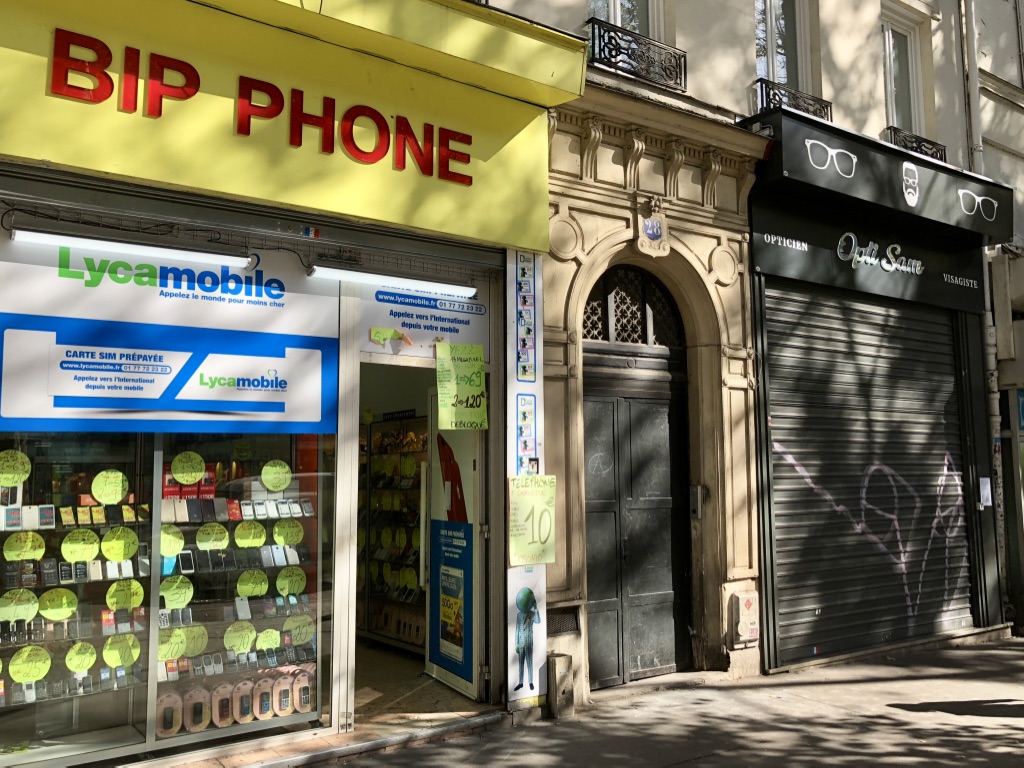
N° 28 Boulevard Barbès: Former residence of Irénée Cazals
And now we come to a shoe shop at N° 34 Boulevard Barbès, one of several shoe shops along the street.

KATA is an outlet store with shoes piled into bins and sold at bargain prices complete with signs saying, ‘No Refunds’. But behind the undistinguished shop front KATA is much more than a shoe shop: it’s an aberration, an urban anachronism.

The shoe shop occupies what was once the Barbès Palace Cinema and when they moved in to the premises in 1988, KATA was persuaded to retain the Belle Époque architecture and fit the shop around it.
This cinema built in 1914 by the French architect Louis Garnier seated 1,200 people making it one of the top cinemas in the city. It was built in the Belle Époque style and the stage, complete with red velvet curtains, the ionic columns, the neo-classical balconies and the double staircase leading up to them are all still in place.

In the early twentieth century cinemas proliferated so the residents around the Boulevard Barbès were spoiled for choice. As well as the Barbès Palace they had the Luxor, (now completely restored and reopened), the Palais-Rochechouart (now Darty), the Delta (now Guerrisol), the Myrha (now an Evangelical Church) and the Gaîté-Rochechouart (now Célio), all within walking distance.
In its early days the Barbès Palace was still influenced by the music hall so it had its own orchestra to provide musical interludes during the programme.
It also had an eye on commercial opportunities so it promoted advertising for a wide range of products and services.

The cinema fared well and up to the mid-1960s offering a programme of mainly French films and a few foreign productions although by this time it had lost both its orchestra and the ‘Palace’ from its name. By the 1970s tastes had changed and the fare on offer tilted towards action movies such as spaghetti westerns and war films. As the decline in cinema going began to bite in the 1980s, the Barbès Cinema began to show double-bills comprising an action movie and an ‘erotic’ film, although it was never reduced to becoming a genuine ‘porn’ cinema.
The final curtain fell on the Barbès cinema on 30th July 1985 with the programme for that week including Ninja Fury and Excès érotiques.

The cinema was built with two means of access: 34 Boulevard Barbès and 9 Rue des Poissonnièrs.
One of my soundwalks comprised a walk along the Rue des Poissonnièrs, into the shoe shop and then out into the Boulevard Barbes. Unfortunately, the ambience inside the shop is tarnished by strips of harsh neon lighting stretching over the displays of shoes and the music playing over loudspeakers scattered around the store.
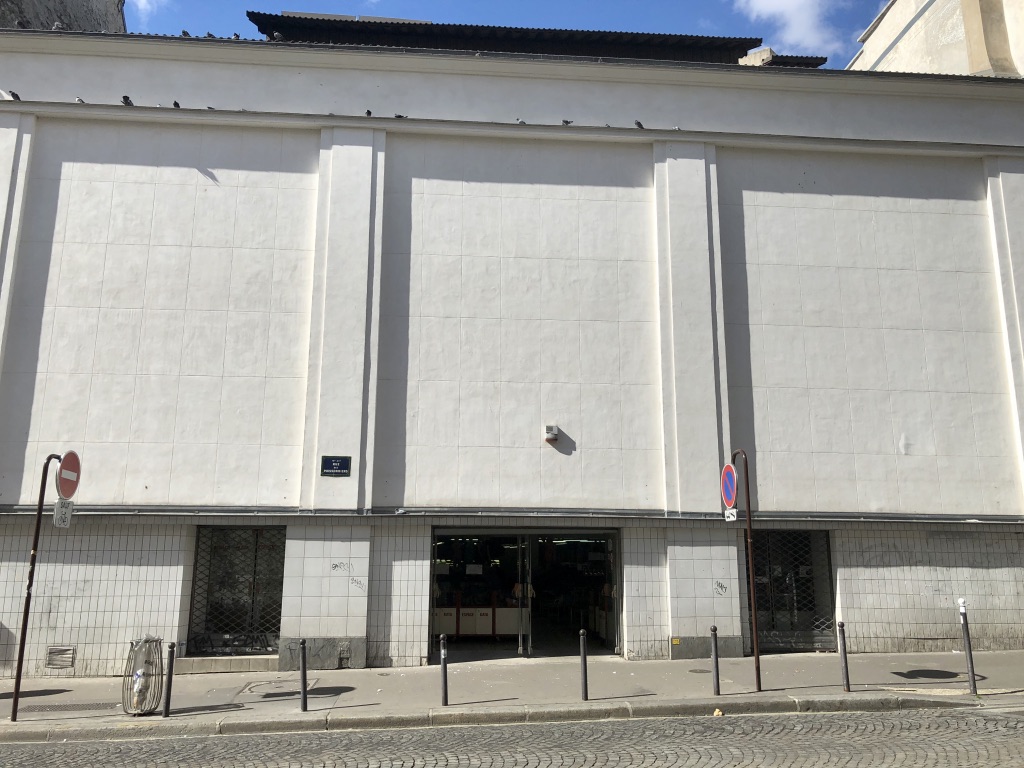
The Rue des Poissonnièrs entrance
A soundwalk from Rue des Poissonnièrs to Boulevard Barbès via the KATA store:
Soundwalking and listening to urban soundscapes has many facets. Studying urban soundscapes can be a valuable academic pursuit as evidenced by the work of Dr. Antonella Raddichi at the Technische Universität, Berlin. Sound artists like La Cosa Preziosa often magically weave urban soundscapes into their compositions. But one doesn’t have to be an academic or an artist to appreciate urban soundscapes. Simply listening to and following the sounds with an abundance of curiosity can open up an often hidden yet fascinating world.
The Changing Soundscape of the Gare du Nord
THE GARE DU NORD railway station in Paris is on the cusp of great change. Over the next few years the physical architecture of this station will be transformed and consequently, so will its sonic architecture.
For many years I have been recording and archiving the sounds of the Gare du Nord. My particular interest lies in investigating how sounds can define, or help to define, a place and how the soundscape of a particular place changes over time. The Gare du Nord is a valuable case study in both these areas.
The first Gare du Nord station was built in 1846 but an increase in traffic meant that a new, bigger station was soon required.

The original 1846 chemin de fer du nord station
Rebuilding took place under the direction of the German-born French architect Jacques Ignace Hittorff with the new station combining the advanced structural use of new materials, notably cast iron, with conservative Beaux-Arts classicism. Hittorff’s Gare du Nord was completed in 1864.

La “Gare de la Compagnie du chemin de fer du Nord” photographiée vers 1864 par Charles-Henri Plaut
Significant changes to the station were made in 1981 to accommodate RER Line B and then in 1993 to accommodate the TGV and the Eurostar. The last major change was 2001 with a major expansion of the departures hall.
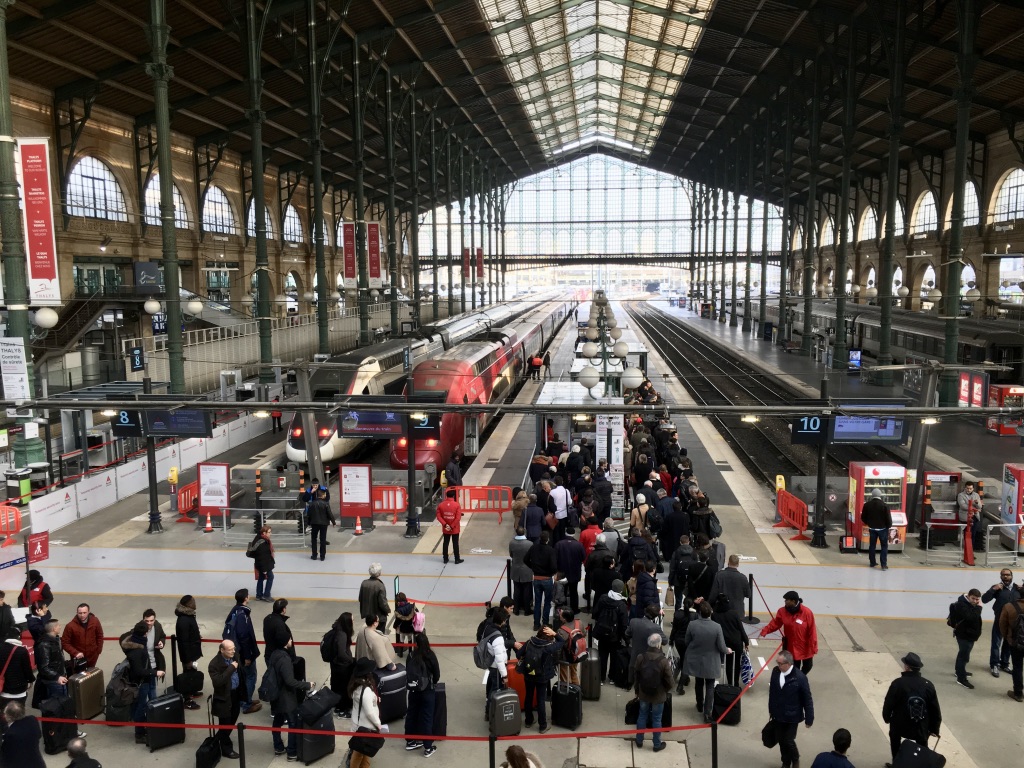
Gare du Nord TGV Departure Hall in 2017
And now the Gare du Nord is about to undergo further change.
Subject to negotiations due to be concluded by the end of this year, SNCF Gares & Connections and the global real estate company Ceetrus will set up a joint venture to carry out a transformation of the Gare du Nord. Ceetrus, in association with architect Denis Valode (Valode and Pistre architects), will lead a transformation as big as that led by the Hittorff in 1864. The transformation is due to be completed in time for the Paris Olympic Games in 2024.

Artist’s impression of the transformed Gare du Nord
The transformation will see the station triple in size from 36,000m2 to 110,000 m2. With 700,000 passengers using the station each day, excluding those who use the associated Métro station, the Gare du Nord is already the busiest railway station in Europe. Following the transformation the daily passenger numbers are expected to increase to 800,000 in 2024 and 900,000 in 2030.
The transformation will include a new departure terminal in which the flow of arrivals and departures from the station will be distinct thus improving fluidity and comfort for travellers. A new station facade is proposed on rue du faubourg Saint-Denis with direct access to the departure terminal.
The Eurostar terminal will be expanded to meet the challenge of strengthened customs controls linked to Brexit.
Accessibility will be enhanced with more elevators and escalators. The new station will have 55 lifts and 105 escalators. Station security will be enhanced with more CCTV being installed.
Access to the three metro lines will be improved. The bus station with its 12 bus lines and 7 Noctilian services will be connected directly with the departure terminal, and 1,200 bicycle parking spaces will be available with direct access from the square in front of the station.
Traffic circulation around the station will be redesigned to take account of the redesigned access to the station and also the expected development of new electric mobility solutions.
The transformed station will also include a 2,000 m2 ‘European Academy of Culture’, a concept devised by the writer Olivier Guez, including a 1,600 m2 space to host events and concerts.
There will be 5,500 m2 of co-working space, a nursery, new restaurants and a one-kilometre running track on the station roof.
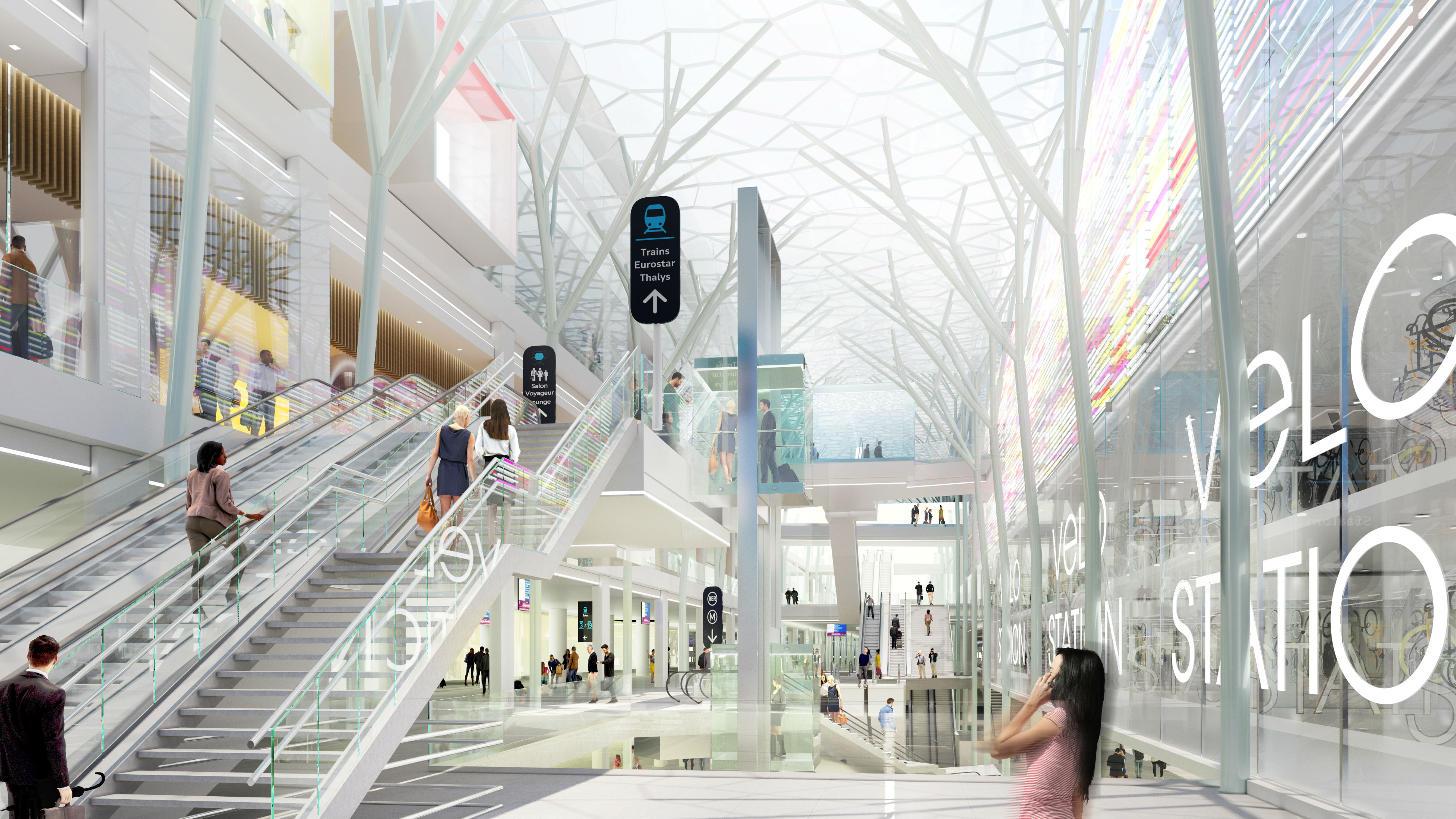
Artist’s impression of the transformed Gare du Nord
The transformation of the Gare du Nord will clearly change the visual landscape of the station but it will also change its sonic landscape. There are six main line railway stations in Paris, five of which sound very similar. The exception is the current Gare du Nord, which has a very distinctive soundscape. The size of the main departures terminal together with Hittorff’s 19th century iron and glass construction and the cacophony of waiting passengers squeezed between the parked trains and the street outside gives the Gare du Nord a very particular sonic ambience.
This is what the Gare du Nord sounded like in 2011.
Gare du Nord 2011:

Gare du Nord Departures Hall 2011
Although the major transformation project is not due to start until next year, some improvements to the Gare du Nord are already underway. When I went there last week I found men laying a new stone floor in the main departures hall, which gives us a clue as to how the soundscape of the station will change as the major construction work progresses. The sounds of the gasping trains will have to compete with the cacophony of building work for some considerable time to come.

Gare du Nord 2018:

Having recorded the soundscape of the current Gare du Nord many times I shall continue to record and archive the sounds as the station’s transformation takes place. I shall be fascinated to discover the sounds of the new, ultra-modern Gare du Nord when all the work is completed. I will though still go back to my archive from time to time and listen to the sounds of the ‘old’ Gare du Nord; sounds that have been so familiar to me for almost the last twenty years and sounds that are about to disappear.

Artist’s impression of the transformed Gare du Nord
La Fête Nationale 2018
YESTERDAY, 14th JULY, WAS a day of national celebration in France. Le Quatorze Juillet, also known as La Fête Nationale, but never Bastille Day as it’s often referred to in English-speaking countries, is the French national day commemorating the 1790 Fête de la Federation held on the first anniversary of the storming of the Bastille on 14th Jul 1789.
Although the day is marked across France, the centerpiece event takes place in Paris with the défilé, the parade of military and civilian services, marching down the Champs Élysée to be reviewed by the Président de la République.
Each year on 14th July a huge crowd lines the Champs Élysées to watch the parade, although how many of them actually see anything is questionable. I though always head to the west of Paris, conveniently close to home, to enjoy a close-up view of the defile aérien, the fly past of aircraft and helicopters of the military and civilian services heading for the Champs Élysées. Being a lifelong enthusiast of both sound recording and aviation, recording a flotilla of aircraft and helicopters flying overhead in close formation at 1,000 feet seems to me to be a perfect way to spend a morning.
A note to the loyal readers who come to this blog to learn more about the social and cultural history of Paris and to enjoy the everyday sounds of the city: Although the rest of this post may seem more suited to aviation geeks like me, please stick with it because, if nothing else, I’m sure you will enjoy the sounds!
This year, 64 fixed wing aircraft took part in the defile aérien: 53 from l’armée de l’air (the French Air Force), 6 from la marine nationale (the French Navy), 2 from la sécurité civile and 3 from other countries comprising an M346 advanced training aircraft from the Republic of Singapore, an Alpha Jet from the Belgian Air Force and an A400M military transport aircraft from the German Air Force.

As always, the défilé aérien opened with nine Alpha Jets of the Patrouille de France, the French aerobatic display team, flying their ‘Big Nine’ formation. But this year there was a twist, an unintentional twist, or as France Info put it: “La Patrouille de France s’est emmêlée les pinceaux dans les couleurs du drapeau.” In other words, the Patrouille de France got in a tangle with the colours of the French flag.
Take a look at the aircraft on the far left of the picture. When a pilot flying in close formation makes a mistake it usually ends badly, but when a pilot in a prestigious aerobatic display team presses the wrong button and emits red instead of blue smoke then that is undoubtedly a bad career move.
Here is a schematic of the aircraft fly past from which you can see the variety of aircraft involved this year.

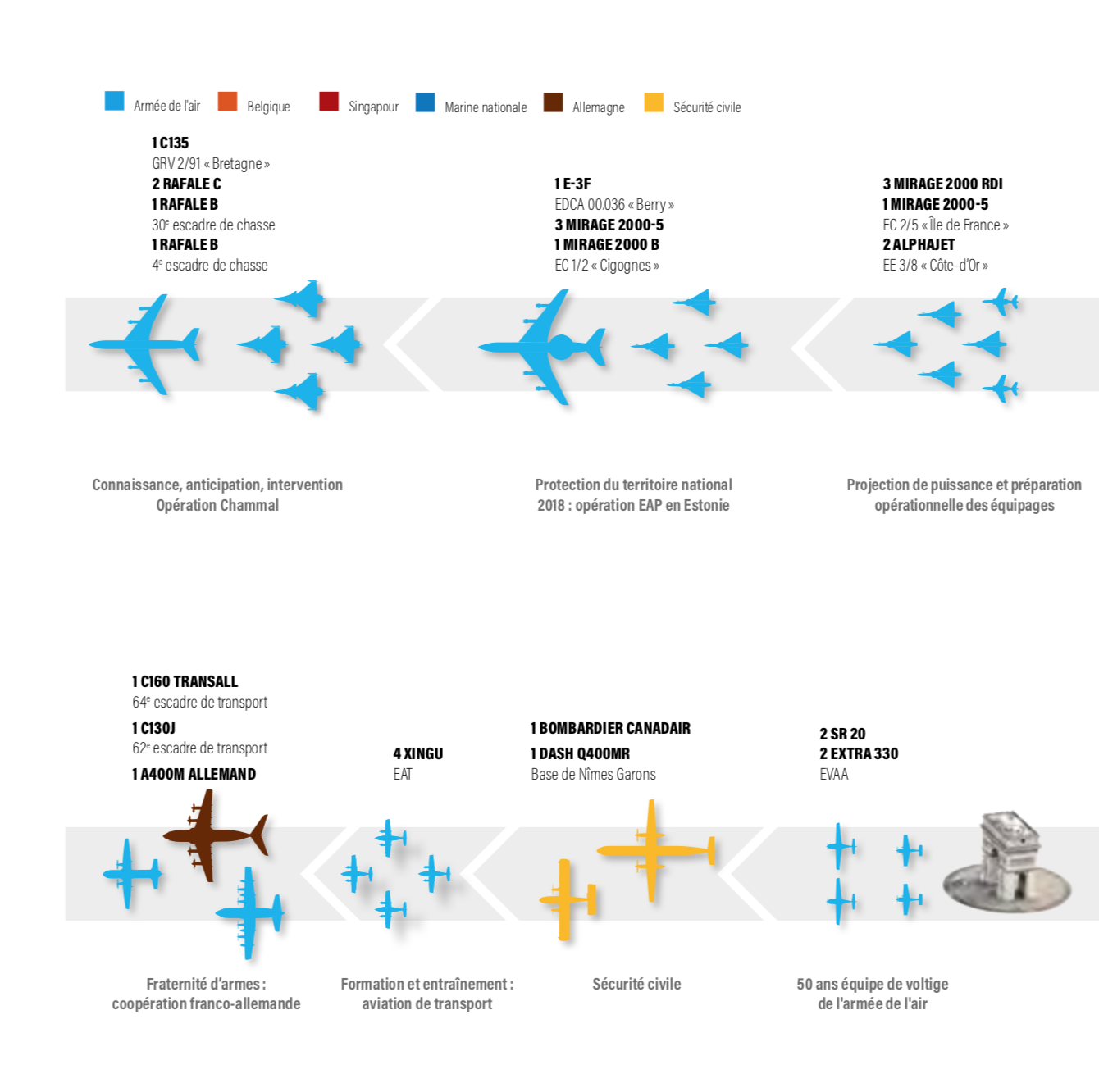
The logistics involved in parading all these aircraft one after the other are complex, not least because the maximum speed of some of the aircraft is slower than the slowest speed of others.
Here are some facts:
From the first aircraft to the last, the fly past stretches for 50 kilometres with 6 kilometres between each block of aircraft. The space between the aircraft flying in close formation is between 5 and 10 metres.
All the aircraft fly past at 1,000 feet, or 305 metres.
The fighter aircraft fly past at 300 knots, around 550 km/h; the navy fighters at 280 knots, around 520 km/h; the navy patrol aircraft at 200 knots, around 370 km/h and the transport aircraft at 180 knots around 330 km/h.
And this is what they sounded like as they passed me today:
Aircraft Fly Past 2018:
I record the sounds of the défilé aérien every year but this year I was able to find a spot to record from that was devoid of people and almost out of earshot of traffic – a rare find indeed.
Some forty-five minutes after the parade of fixed wing aircraft it was time for the rotary wing flotilla; the helicopters.

Here is a schematic showing the helicopters on display today.


This year, there were 30 helicopters, including 18 light aviation helicopters from the army; five helicopters from the air force; two from the navy; three from the gendarmerie and two from the sécurité civile.
From the first helicopter to the last, the fly past stretched for 8 kilometres with 1 kilometre between the two main aircraft blocks. They flew at a height of 400 feet, 120 metres, at a speed of 90 knots or 170 km/h.
And this is what they sounded like as they passed overhead:
Helicopter Fly Past 2018:
While recording the sounds of the défilé aérien I was able to use my smart phone to take some pictures. Unfortunately, my competence at multitasking didn’t stretch to capturing pictures of every passing aircraft so, for those of you who would like to know more about at least some of the aircraft taking part in this year’s défilé aérien here are some of the pictures I captured.

A C135 air refueling tanker from Flight Supply Group 2/91 “Brittany”, followed by a Mirage 2000N from Fighter Squadron (EC) 2/4 “La Fayette”, and three Rafale from EC 1/4 “Gascogne”.

An Airbus A330 MRTT (Multi Role Tanker Transport), a new multi-role aircraft providing personnel and freight transport, air refueling and intelligence gathering. It is followed by four Mirage 2000D from N° 3 Fighter Wing.

A C135 refueling aircraft from Flight Replenishment Group 2/91 “Brittany” followed by four Rafale (three Rafale C two-seater and one single-seater Rafale B) from the 30th Fighter Wing.

An Awacs E-3F from the Airborne Warning and Control Squadron 00/036 “Berry” followed by four Mirage 2000-5s from EC 1/2 “Cigognes”.

Four Mirage 2000 from the EC 2/5 “Ile-de-France” and two Alpha Jets from the 3/8 “Côte d’Or” training squadron, the only French squadron simulating enemy action to train pilots and confronting them with all types of threats.

Two Alpha Jets from l’École d’aviation de chasse (EAC) at̀ Tours and three Alpha Jets from l’École de transition opérationnelle (ETO) at Cazaux, including one Belgian Alpha Jet, and one Singaporean M346 from the 150th Squadron stationed at Cazaux Air Base. For 20 years, a detachment of the Singapore Air Force has been stationed there to train its fighter pilots.

An Airbus A340 from the 3/60 “Esterel” Transport Squadron.

An A400M Atlas from 61 Wing and two Casa CN 235 from 1/62 “Vercors” and 3/62 “Ventoux” Transport Squadrons.

A Canadair CL415 and a Dash Q400 MR from la sécurité civile used in fighting forest fires. These aircraft have been deployed in the firefighting role in France, Europe and in the rest of the world.
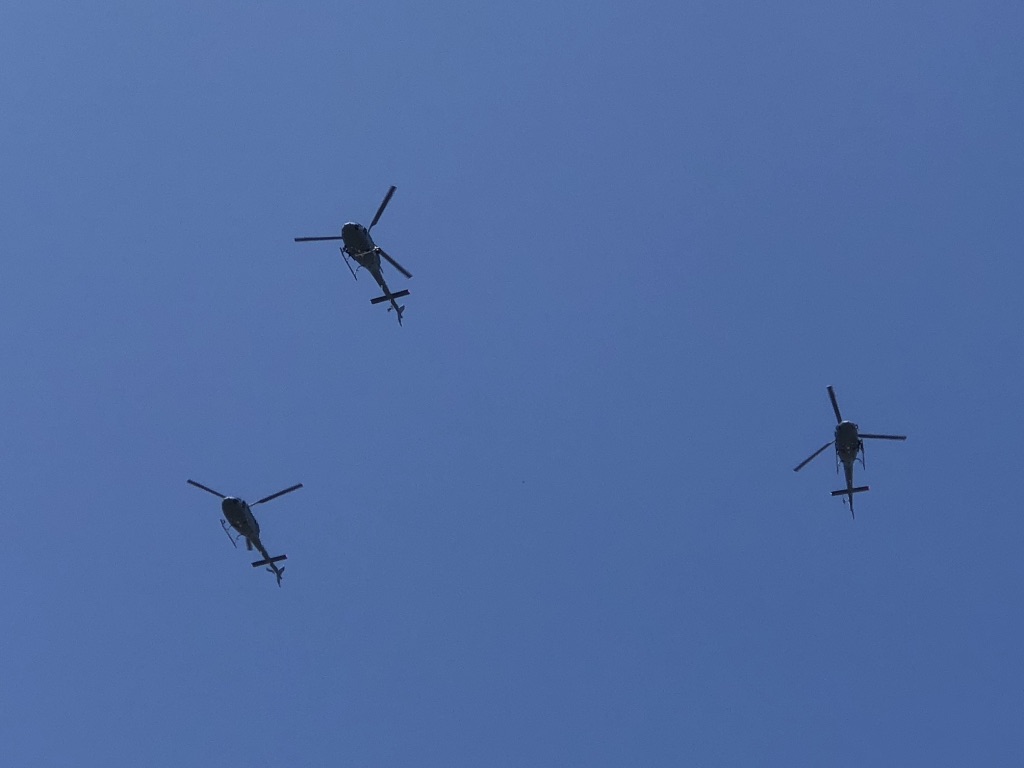
Two Airbus lightweight, multipurpose Fennec helicopters from the helicopter squadron 3/67 “Parisis” and one from 5/67 “Alpilles”.
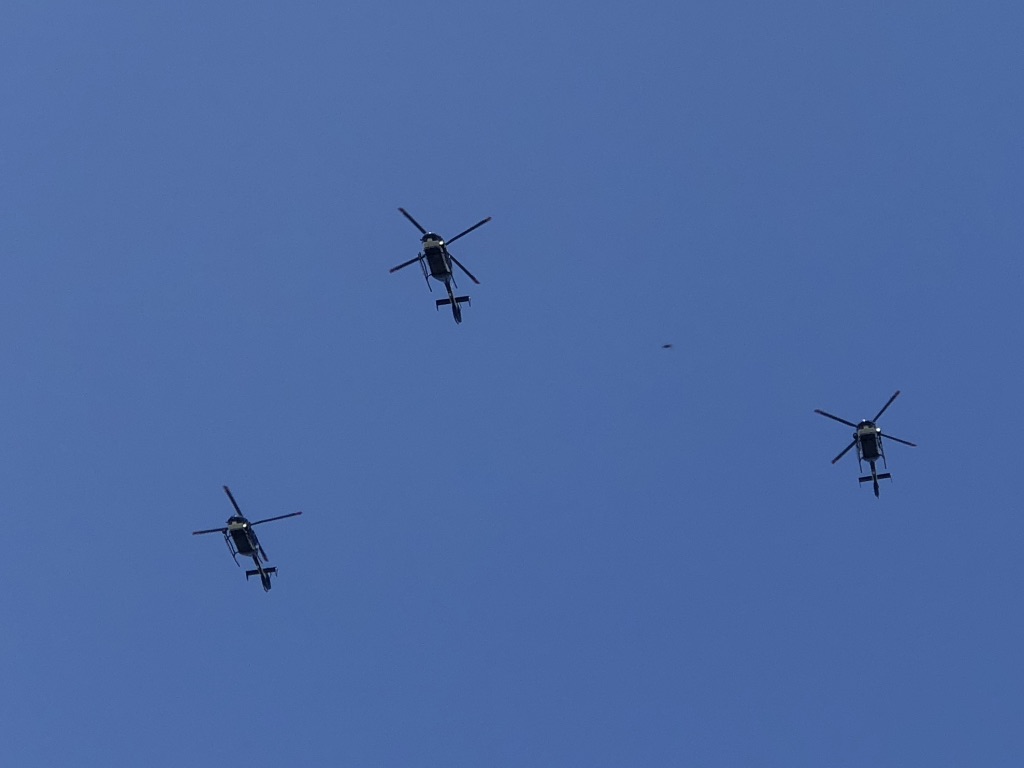
One EC145 and two EC135 helicopters from the gendarmerie nationale.

An HAP Tiger, followed by a Cougar, and a Gazelle from the 4th Special Forces Helicopter Regiment.
End of the Line: La Défense – Grande Arche: Part 2
FOLLOWING ON FROM my previous post, this segment of my ‘End of the Line’ series continues my exploration of the sounds in and around La Défense – Grande Arche, the westerly terminus of Paris Métro Line 1.
In the previous post I explored the sounds inside the station complex and so I turn now to my exploration outside the station.

La Défense from Pont de Neuilly
Bearing in mind that sounds don’t exist in a vacuum, my exploration of the sounds of a place invariably lead me to explore the history of that place in order to underpin today’s sounds and to give the sounds a broader context.
We know something about the area now known as La Défense long before it came to prominence as the purpose-built business district of Paris that it is today.
Emile Zola touches on it in the opening chapter of his nineteenth-century novel, Le Ventre de Paris:
“Amidst the deep silence and solitude prevailing in the avenue several market gardeners’ carts were climbing the slope which led towards Paris, and the fronts of the houses, asleep behind the dim lines of elms on either side of the road, echoed back the rhythmical jolting of the wheels. At the Neuilly bridge a cart full of cabbages and another full of peas had joined the eight wagons of carrots and turnips coming down from Nanterre; and the horses, left to themselves, had continued plodding along with lowered heads, at a regular though lazy pace, which the ascent of the slope now slackened. The sleeping wagoners, wrapped in woollen cloaks, striped black and grey, and grasping the reins slackly in their closed hands, were stretched at full length on their stomachs atop of the piles of vegetables. Every now and then, a gas lamp, following some patch of gloom, would light up the hobnails of a boot, the blue sleeve of a blouse, or the peak of a cap peering out of the huge florescence of vegetables — red bouquets of carrots, white bouquets of turnips, and the overflowing greenery of peas and cabbages.
And all along the road, and along the neighbouring roads, in front and behind, the distant rumbling of vehicles told of the presence of similar contingents of the great caravan which was travelling onward through the gloom and deep slumber of that matutinal hour, lulling the dark city to continued repose with its echoes of passing food.”
Le Ventre de Paris: Emile Zola: Published in 1873
In the eighteenth and early nineteenth century the area of Nanterre, around what we now know as La Défense, was mainly cultivated land growing cereals, vines and vegetables. It was from this cultivated land that Emile Zola’s wagoners were hauling their vegetables to Les Halles, the vast central market in the centre of Paris.
Le Ventre de Paris may be a work of fiction but Emile Zola was known as an astute observer of Parisian life so his description of the wagoners at Pont de Neuilly on their way from Nanterre to Les Halles gives us a sense of what this area was probably like in the nineteenth century.
What is now the business district of La Défense takes its name from a statue erected in 1883. Created by the French sculptor Louis-Ernest Barrias, the statue, La Défense de Paris, is a monument to those who defended Paris in the Franco-Prussian War of 1870 – 1871. The statue depicts a woman dressed in a uniform of the National Guard leaning on a cannon and holding a flag. She represents the allegorical figure of the city of Paris. The defenders of the city take on the features of a young soldier who places a last cartridge in his Chassepot rifle. The two figures were originally looking towards Buzenval, the place of the last combats in January 1871. On the other side of the monument is a prostrate girl who, with her sad expression and miserable appearance, personifies the sufferings of the civilian population.
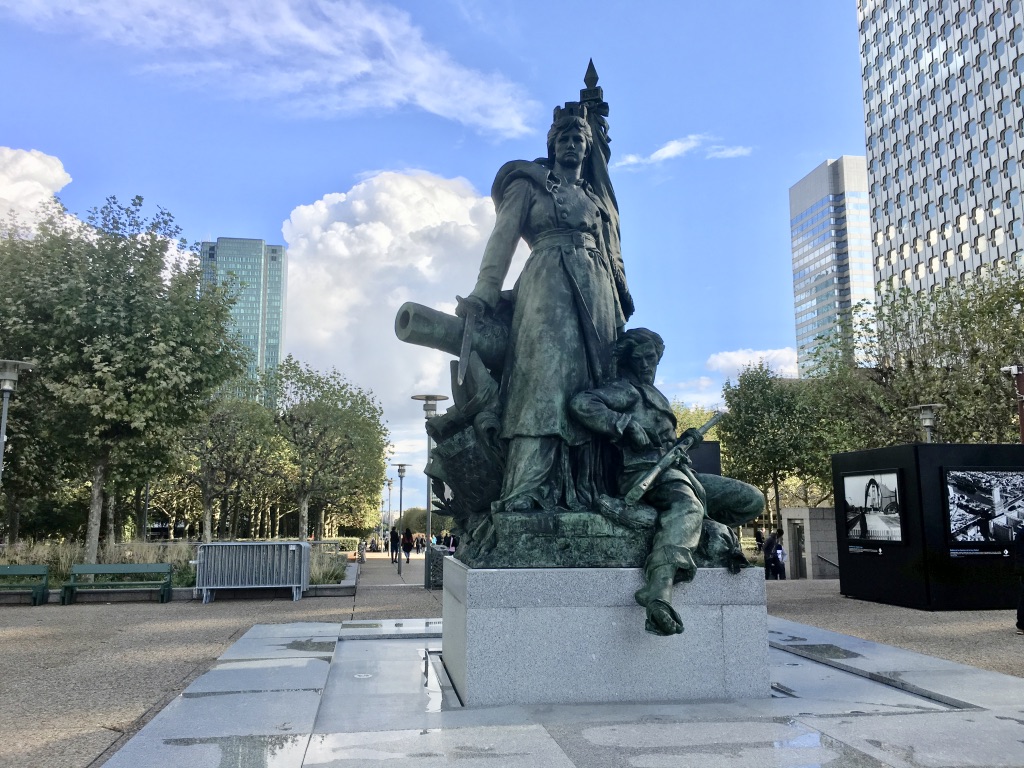
La Défense de Paris by Louis-Ernest Barrias
From 19th September 1870 to 28th January 1871, Paris was under siege by Prussian forces surrounding the city.
Conditions in Paris deteriorated and there was soon a severe shortage of food. Parisians were forced to eat whatever animals were at hand. Rats, dogs, cats, and horses were the first to be slaughtered and became regular fare on restaurant menus. Once the supply of those animals ran low, the citizens of Paris turned on the zoo animals at the Jardin des Plantes. Even Castor and Pollux, the only pair of elephants in Paris, were slaughtered for their meat.

A Christmas menu on the 99th day of the siege. Dishes include stuffed donkey’s head, elephant consommé, roast camel, kangaroo stew, antelope terrine, bear ribs, cat with rats, and wolf haunch in deer sauce.
Besieged French troops attempted several breakouts to take the fight to the Prussians. On 19th January 1871, they assembled in the area around today’s La Défense in preparation for an attack on the Prussian army. Led by General Louis Jules Trochu, military governor of Paris and president of the Provisional Government, their efforts were insufficiently prepared and incompetently led and so consequently failed.
“We had conquered several commanding heights which the generals did not arm. The Prussians were allowed to sweep these crests at their ease, and at four o’clock sent forth assault columns. Ours gave way first, then, steadying themselves, checked the onward movement of the enemy. Towards six o’clock, when the hostile fire diminished, Trochu ordered a retreat. Yet there were 40,000 reserves between Mont-Valdérien and Buzenval. Out of 150 artillery pieces, thirty only had been employed. But the generals, who during the whole day had hardly deigned to communicate with the National Guard, declared they could not hold out a second night!, and Trochu had Montretout and all the conquered positions evacuated. Battalions returned weeping with rage. All understood that the whole affair was a cruel mockery.”
History of the Paris Commune 1871: Prosper-Olivier Lissagaray: Published in 1877
The siege of Paris ended on the 28th January 1871 when the French Government, safely housed in Versailles, surrendered, although the City of Paris notably did not formally surrender. It was this division between the leaders and the led that helped created the Paris Commune in 1871.

The prospect from the Grande Arche de la Défense looking over the parvis to the Arc de Triomphe
In Part 1 of this ‘End of the Line’ segment I explored the sounds inside the La Défense – Grande Arche transport hub, which extends underneath the monumental Grande Arche de la Défense and the parvis in front of it. So here are the sounds I discovered after I ascended an escalator out of the station and emerged onto the surface:
Sounds around La Défense – Grande Arche:

La Grande Arche de la Défense
Any exploration of La Défense has to begin with the Grande Arche de la Défense simply because it dominates the area.
Designed by the Danish architect Johann Otto von Spreckelsen (1929–1987) and Danish engineer Erik Reitzel (1941-2012), the Grande Arche is a late twentieth century version of the Arc de Triomphe although it is a monument to humanity and humanitarian ideals rather than military victories. Construction began in 1985 and although Spreckelsen resigned in July 1986 his associate, French architect Paul Andreu, took over. Erik Reitzel continued his work until the monument was completed.
La Grande Arche was inaugurated in July 1989, coinciding with the bicentennial of the French Revolution. It completed the line of monuments that form the Axe historique running through Paris, which includes the Arc de Triomphe in the Champs Elysées, the Luxor Obelisk at the Place de la Concorde and the Arc de Triomphe du Carrousel at the Louvre.
A curiosity of the Grande Arche is that it is turned at an angle of 6.33° about the vertical axis. This is because with a Métro station, an RER station and a motorway all situated directly underneath the Arche, the angle was the only way to accommodate the structure’s giant foundations.
The two sides of the Arche house government offices and the rooftop is open to the public and includes a restaurant and an exhibition space.

As you can hear in my sound piece, when I came out from the escalator and made my way to foot of the Grande Arche I found a huddle of people getting very excited about an autonomous electric bus that carries people like me who these days often find it a stretch to walk too far.
Forsaking the bus on this occasion though, I walked from the Grande Arche to Les Quatre Temps shopping centre (centre commercial) on the southern side of the parvis of La Défense, reportedly one of the most visited shopping centres in France.

Inside Les Quatre Temps
Designed by the architects Guy Lagneau and Jean Dimitrijevic of the Atelier AWD, also known as ATEA (Atelier d’Etudes Architecturales), the project was completed in 1981.
The 120,000 m2 shopping center was completely renovated between 2006 and 2008. The renovation took place in several phases and involved the interior spaces, the exterior facades and the shops. At first, the shopping mall was extended to the west, encompassing the former colline de l’automobile. This extension, located on the 3rd floor of the center called “The Dome” included twenty-two restaurants and a new sixteen screen multiplex cinema, UGC Cine Cité La Défense. The renovation to the east, included a Castorama store replacing the original UGC cinema. The exterior facades of Les Quatre Temps are currently undergoing further renovation.
Looking ahead, a new station, part of the Grand Paris Express, is to be built under Les Quatre Temps. It is due to be completed in 2027.
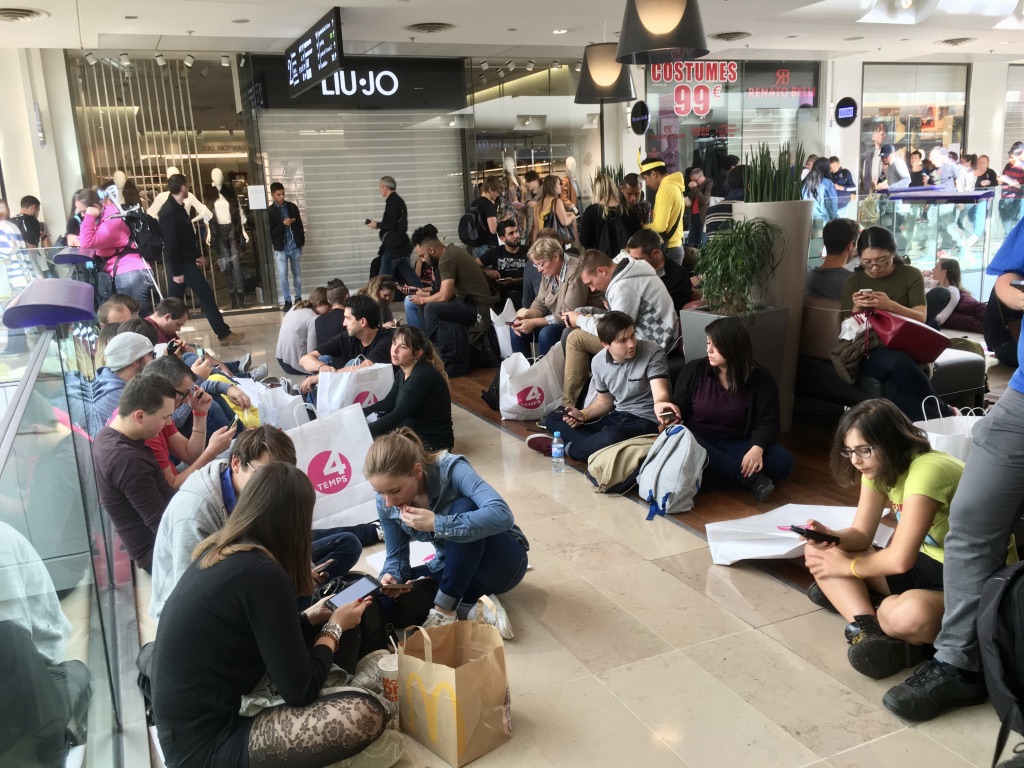
Inside Les Quatre Temps
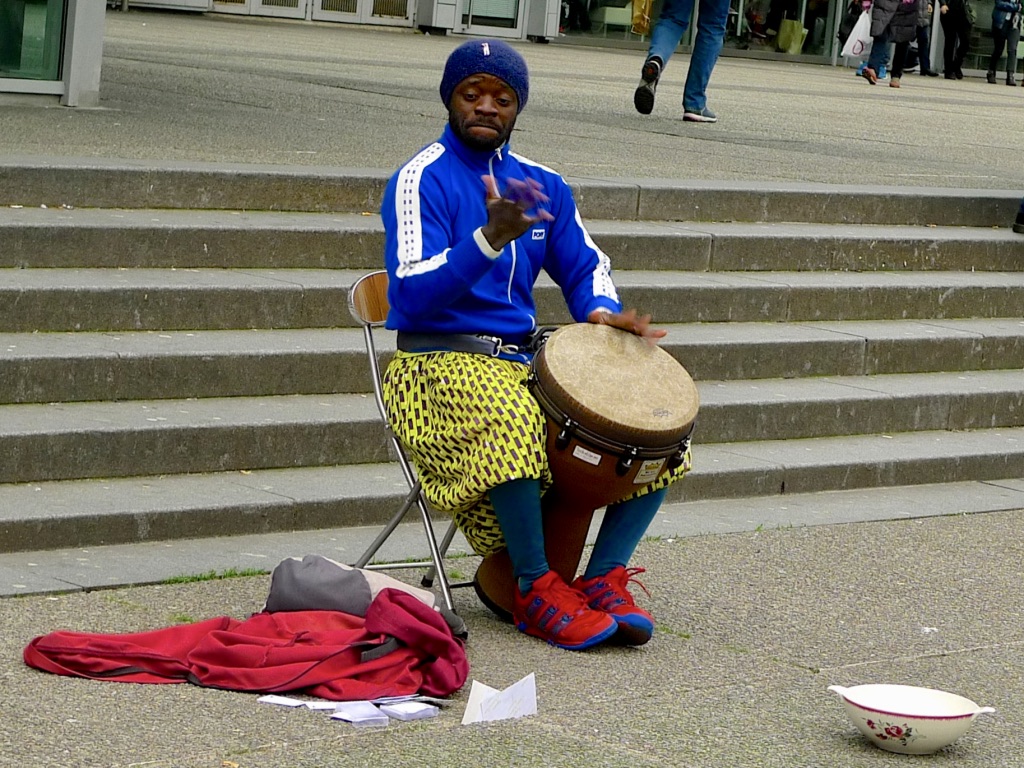
Coming out of Les Quatre Temps I came upon this man sitting on the steps playing his drum.
When it was first installed, the statue La Défense de Paris, to which I referred earlier, was installed in the middle of a roundabout at a busy road junction. As the business district of La Défense was being developed, the statue was moved several times; the current parvis of La Défense was built over the site of the roundabout. In January 2017, the statue was moved to the place where it now stands, just beyond the Fontaine monumentale.
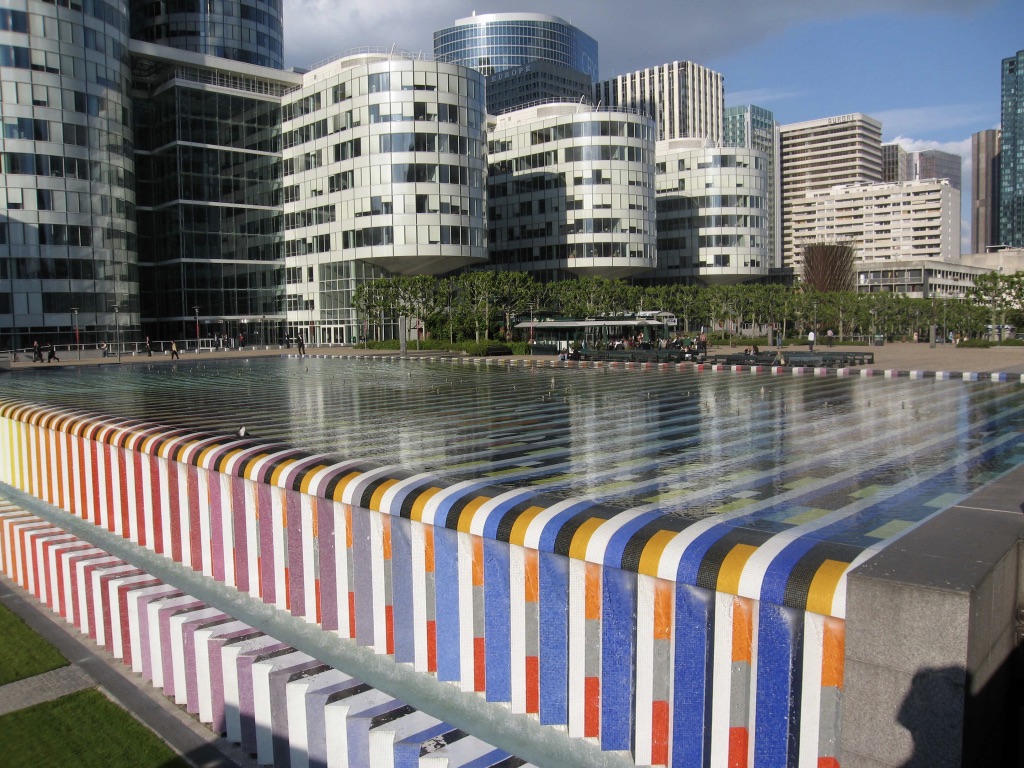
The Fontaine monumentale was created by Yaacov Agam, an Israeli sculptor and experimental artist best known for his contributions to optical and kinetic art. The fountain’s 57m by 26m pool has a polymorphic mosaic surface comprising enamel of different colours made in Venice. The fountain is powered by 66 vertical autonomous water jets shooting water up to 14 meters.
Incidentally, recording the sounds of a fountain is not as easy as you might think!

To complete my exploration I walked back to northern side of the parvis to the very distinctive CNIT.
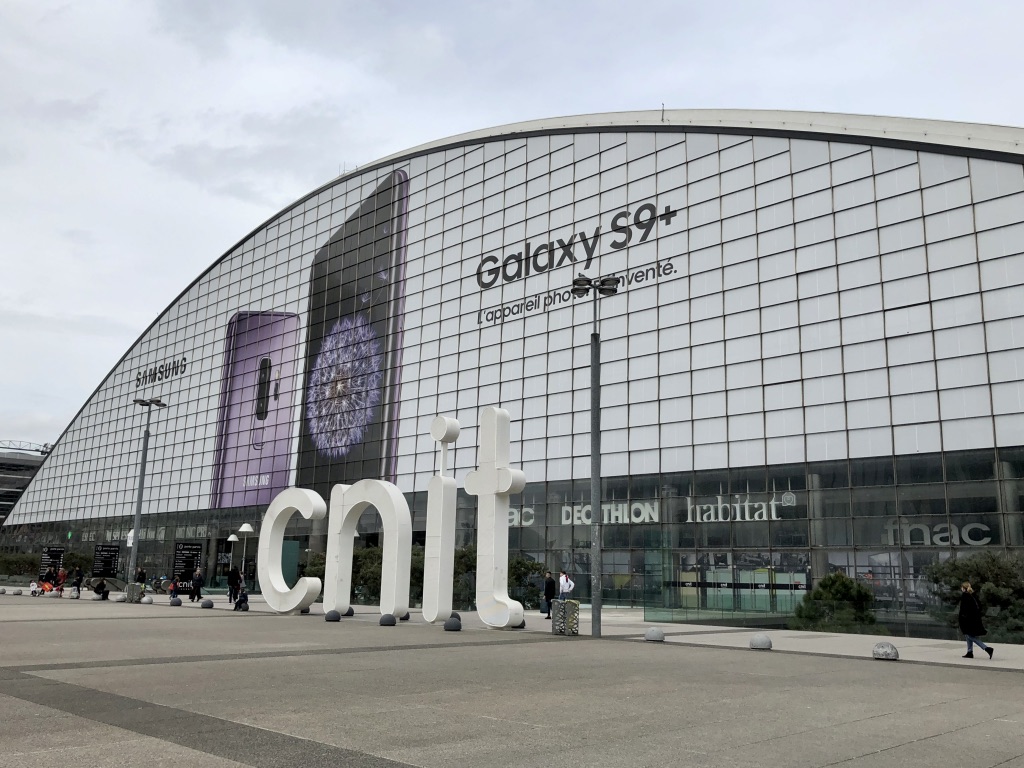
Built in 1958, the CNIT (Centre des nouvelles industries et technologies) was the first building to be built in La Défense. Its characteristic shape is due to the triangular plot it occupies. Since it was built, it has undergone two major renovations; in 1988 and 2009.
Designed by the architects Robert Camelot, Jean de Mailly and Bernard Zehrfuss, the most distinctive feature of the CNIT is its freestanding 22,500 m2 reinforced concrete vaulted roof, which has a span of 218 meters and is only 6 cm thick.
Today the CNIT houses offices and a two-level shopping centre hosting enterprises like Fnac, Decathalon, Habitat, La Poste and Monoprix as well as a several restaurants and a Hilton hotel.
A station, part of the extension of RER Line E is to be built under the CNIT and is expected to open in 2020.

The CNIT with its distinctive concrete roof
I couldn’t possibly leave La Défense without stopping to look at La Pouce, César Baldaccini’s iconic sculpture of a 40-foot thumb in Place Carpeaux next to the CNIT.
Baldaccini created this sculpture from an enlarged moulding of his own thumb using the 3-D pantographic technique.
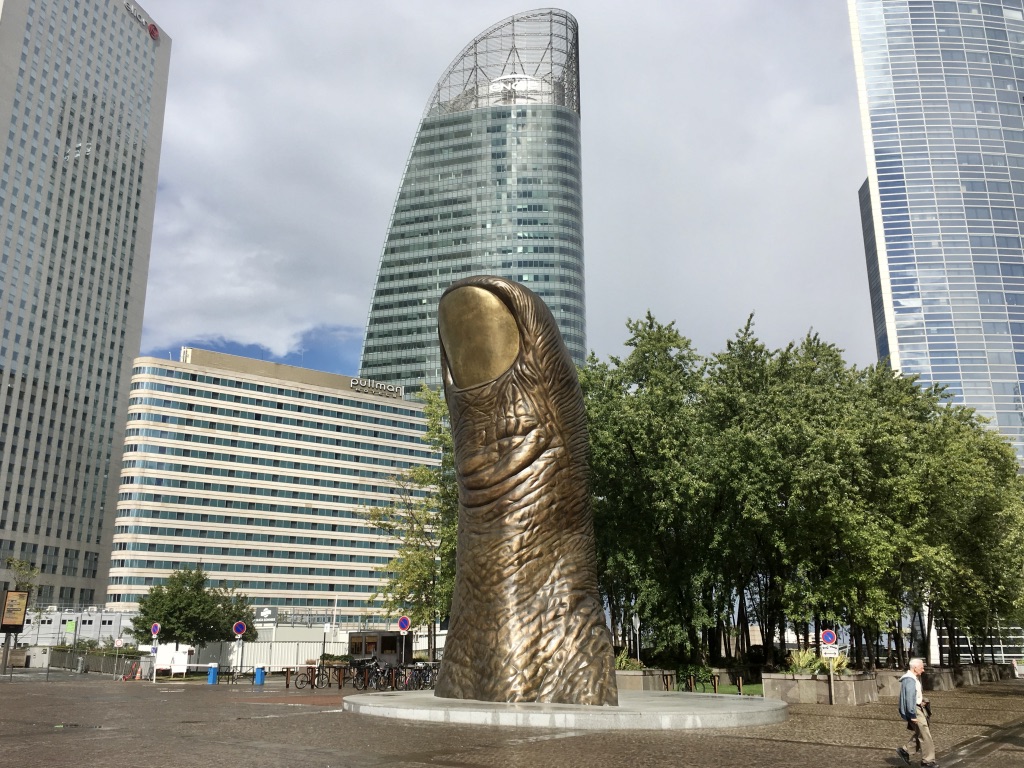
To digress for a moment:
I used to work in La Défense. For thirteen years my office was in the Ernst & Young building (the tall building on the left in the picture above) so every time I went to my office I used to walk past Baldaccini’s 18-ton, cast iron thumb.
The building directly behind Baldaccini’s thumb in the picture is the GDF – Suez building, which I can remember when it was nothing more than a car park. I was looking down from my office window at the car park one day when men arrived and began to erect a fence around it. Several days later a procession of diggers arrived and began tearing up the car park and digging what turned out to be the biggest hole I’d ever seen. Over the coming months there emerged from this hole layer after layer of what is now the 185 metre, 37 storey, GDF –Suez building. My audio diary is littered with entries at the time reporting that yet another floor of the building was in place.

Another view of the GDF – Suez building
So that completes my exploration of the area outside, around the station La Défense – Grande Arche. As always, it was exploring the sounds of this place that brought me here and led me to discover much more about the history of La Défense as well as encouraging me to revisit some of the parts of La Défense that I knew from when I worked here.
The sounds you heard were:
Rising up the escalator out of the underground station; people around the autonomous electric bus; excited children on the parvis watching a man creating huge soap bubbles; inside Les Quatre Temps; the African drummer; the Fontaine monumentale; sounds inside Le CNIT and out on the Parvis de la Défense.
I hope both these sounds and the underground sounds in Part 1 give you a flavour of the sonic tapestry that is La Défense.

End of the Line: La Défense – Grande Arche: Part 1
THE ‘END OF THE LINE’ STRAND in my Paris Soundscapes Archive is dedicated to the sounds I capture in and around each terminus station on the Paris Métro system. From time to time I share the atmosphere of some of these terminus stations and their surroundings on this blog.
In previous ‘End of the Line’ posts I’ve explored the sounds in and around the Métro station Les Courtilles, the branch of Paris Métro Line 13 terminating in the northwest of Paris, and the sounds in and around Métro station Château de Vincennes, the easterly terminus of Paris Métro Line 1. Now I’m going to explore the sounds in and around the Métro station La Défense – Grande Arche, the westerly terminus of Métro Line 1.
However, to make this ‘End of the Line’ segment more manageable I will divide it into two parts. Today’s post, Part 1, explores inside La Défense – Grande Arche station and the next post, Part 2, will explore the sounds around the station in what is said to be Europe’s largest purpose-built business district containing most of the Paris urban area’s tallest high-rise buildings.
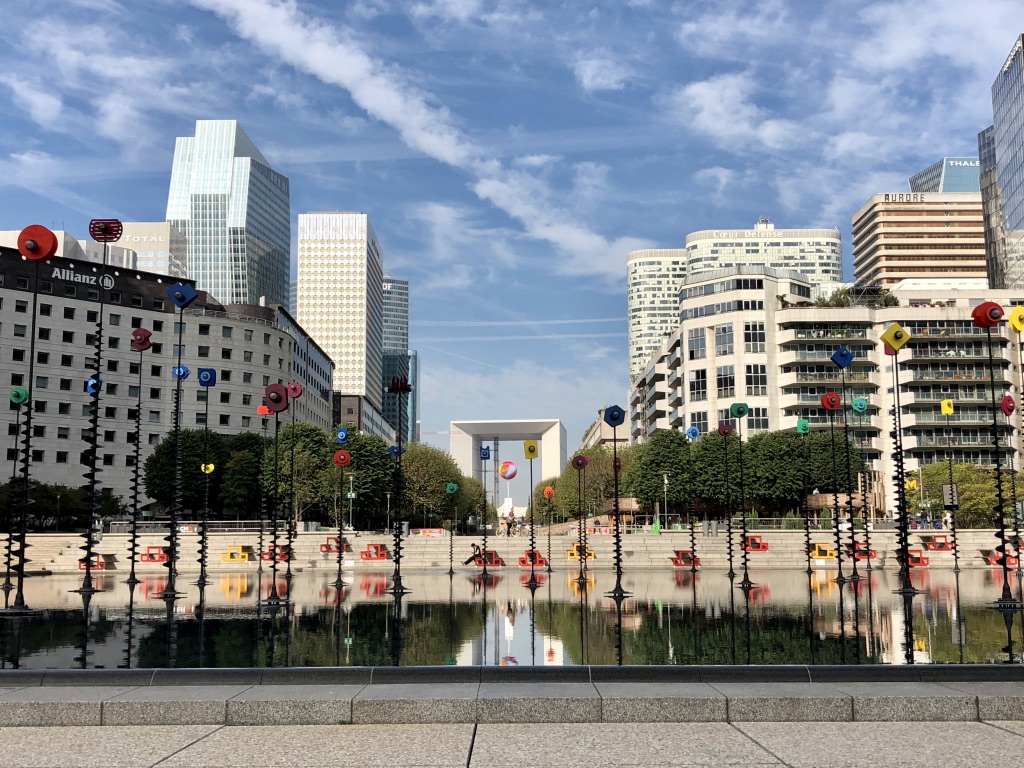
La Défense looking to the West
Because it serves the largest business district in the Paris region, La Défense – Grande Arche is a multi-functional transport hub. Not only is it home to the western terminus of Métro Line 1, it also houses a Transilien suburban train station, an RER station, a tram station and a bus station, all designed principally to handle the huge number of commuters who travel to and from work in La Défense each day.

La Défense – Grande Arche: The main concourse
The business district of La Défense is so big that it actually has two Métro stations. Esplanade de la Défense is the first of these so it was approaching here on my way to La Défense – Grande Arche that I began my sonic exploration.
Exploring La Défense – Grande Arche station in sound:
Opened on 19th July 1900, Métro Line 1 is the oldest line on the Paris Métro network. Built by the one-armed railway engineer Fulgence Bienvenüe, to connect various sites of the 1900 Exposition Universelle, the original line comprised eighteen stations between Porte Maillot and Porte de Vincennes. In 1934, the line was extended to the east from Porte de Vincennes to Chateau de Vincennes and in 1937 it was extended to the west from Porte Maillot to Pont de Neuilly. In 1992, Line 1 was extended again to the west from Pont de Neuilly to La Défense. In 2007, work began to automate Line 1 and on 15th December 2012 a fully automatic service was introduced. Today the 16.5 km Métro Line 1 is the most utilised line on the Paris Métro network handling over 600,000 passengers per day.

Arriving at the La Défense – Grande Arche terminus, I alighted and made my way up to the cavernous station concourse. This used to be a dingy, inhospitable place but a recent coat of paint has brightened it up a bit and now, the usual suspects cater for the commuters.

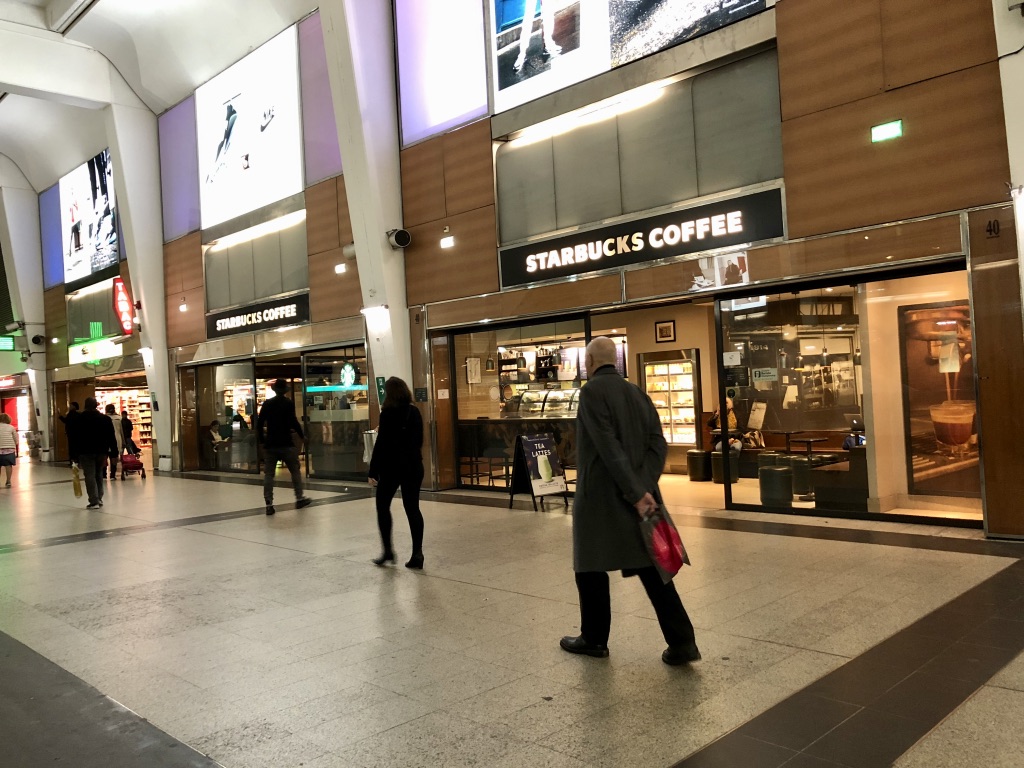
From the main concourse I headed off to explore the tram station, home to Tram Line T2.
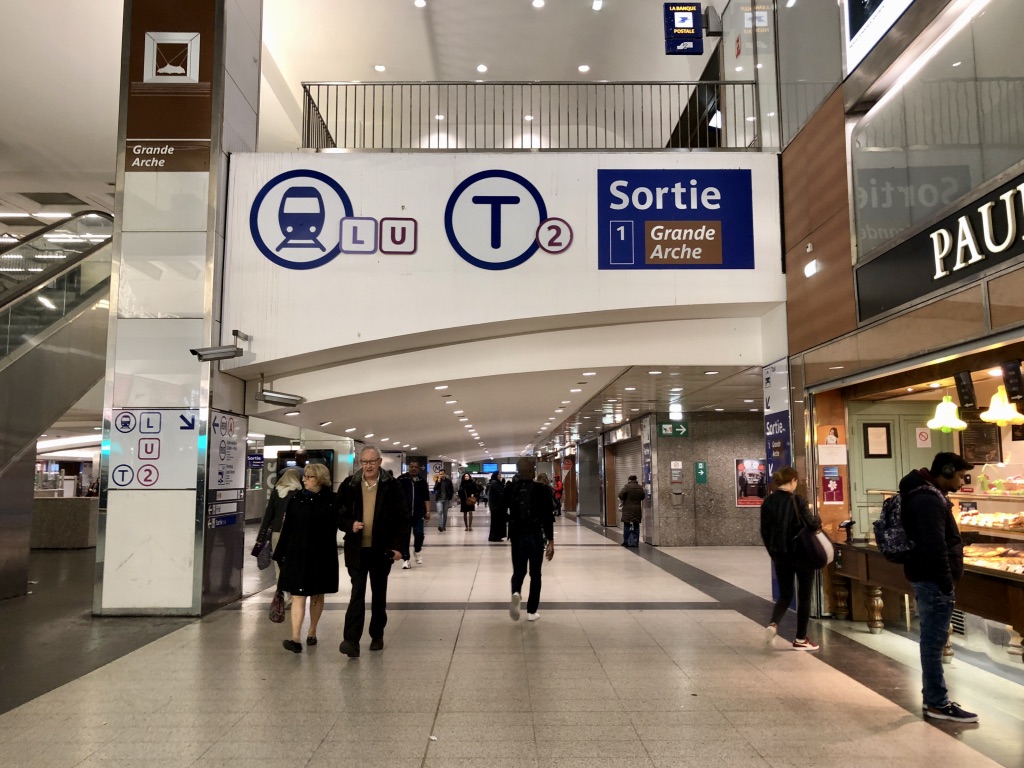
Tram Line T2, linking the south-west suburbs of Paris with La Défense, began operating in 1997. The tramway was built on the former train line thus making it independent from the road. An extension In 2009 added five more stations towards the south, extending to Port de Versailles and in November 2012, another 4.2 km northern extension beyond La Défense to Bezons added a further seven stations.
The extensions to Tram Line 2 are part of a larger scheme in the Île-de-France aiming to increase connectivity of the suburbs by creating up to 70km of bus and tramways around Paris.
The Transilien suburban trains operate from platforms adjacent to but separated from the tram platforms.

While the public address announcements in the main station concourse are almost unintelligible, those in the tram station are much better – even if they do seem to appear end-to-end.
From the tram station I went back to the concourse and on to the RER station and RER Line A.

With more than one million passengers a day, RER Line A is the busiest Parisian urban rail line.
With the section of the line running through the city centre closed each summer for maintenance and construction work, much to the dismay of commuters, and with the line badly affected by alerts for suspect packages, which have doubled in the last year, it’s hardly surprising that, according to a 2017 survey by transport authorities in the greater Paris region, trains on RER Line A run on time only 85.3% of the time. Add to that grossly overcrowded trains and the occasional strike and RER Line A can sometimes be a challenge.
Despite the introduction of advanced traffic control systems that enable extremely short spacing between trains during rush hour (under 90 seconds in stations, under 2 minutes in tunnels) together with several upgrades in rolling stock, ever-increasing traffic volume and imminent saturation continues to blight the line.
Still, it’s not the worst performing RER line. According to the 2017 survey, that accolade goes to RER Line D.

The sounds of La Défense – Grande Arche presented in this post are a distillation of my original ninety minute recording now consigned to my Paris Soundscapes Archive but I hope they give you at least a flavour of the sonic tapestry hidden below the monumental Grande Arche de la Défense. In Part 2, I shall explore the sounds up on the surface.

Even with this extensive transport facility complete with its coffee shops and fast food outlets, travelling to and from La Défense during the rush hour each day can be a grim experience. I know, I did it for thirteen years!
Les Cloches de Notre-Dame – The City Singing
WRITING ABOUT PARIS IN his novel, Notre-Dame de Paris, also known as The Hunchback of Notre-Dame, published in 1831, Victor Hugo said:
“And if you wish to receive of the ancient city an impression with which the modern one can no longer furnish you, climb – on the morning of some grand festival, beneath the rising sun of Easter or of Pentecost – climb upon some elevated point, whence you command the entire capital; and be present at the wakening of the chimes.”
“… Ordinarily, the noise which escapes from Paris by day is the city speaking; by night, it is the city breathing; in this case, it is the city singing.”
Yesterday, on Easter Sunday, one of Hugo’s grand festivals, I took his advice and climbed upon some elevated point and was present at the wakening of the chimes.
To listen to the city singing, I climbed to an elegant apartment on the fourth floor of a very old building on the Île de la Cité in the heart of medieval Paris and while my elevated point did not command the entire capital as Hugo suggested it should, it did nevertheless command a stunning view of the Cathédrale Notre-Dame de Paris.

From this exclusive vantage point I was able to listen to and to capture the pealing bells of Notre-Dame while being shielded from many of the other sounds that usually surround the cathedral.
Any Sunday morning in Paris will echo to the sound of church bells but the sound of the bells of Notre-Dame are different. Not only do they represent the contemporary soundscape, they also reflect something unique: a genuine soundscape pre-dating the French Revolution.
Les cloches de la cathédrale Notre-Dame de Paris:

Bells have rung out from the Cathédrale Notre-Dame de Paris since the end of the twelfth century, long before the building of the cathedral was completed. As the cathedral’s life evolved and its influence developed more bells were added to reflect its increasing importance.
By the middle of the eighteenth century Notre-Dame had a magnificent array of bells: eight in the north tower, two bourdons, or great bells, in the south tower, seven in the spire and three clock bells in the north transept.
But their days were numbered. The ravages of the French Revolution took their toll and the bells were removed, broken up and melted down. One bell though escaped this destruction. The biggest of the cathedrals’ bells, the great Emanuel bell, was saved and reinstalled on the express orders of Napoleon I and it still hangs in the south tower today.
After the dust of the Revolution settled new bells were installed in Notre-Dame: four in the north tower, three in the spire and three in the roof of the transept. Unfortunately, the best that can be said about these new bells is that they were second rate. Poor quality metal was used to cast them and they were out of tune with each other and with the magnificent Emanuel bell. And these second rate bells are what Parisians lived with from just after the Revolution until 2013, when everything changed.
To mark the 850th anniversary of the founding of the Cathédrale Notre-Dame de Paris it was decided to replace the existing cathedral bells with new ones, exact replicas of the bells that were in place before the Revolution. With eight new bells in the north tower cast at a foundry in Normandy and a new bourdon cast in the Netherlands sitting beside the frail and now very carefully used Emanuel in the south tower, once again the soundscape of eighteenth century Paris, lost for over two centuries, could be heard.

Every time I hear the bells of the cathédrale Notre-Dame de Paris I pause and remember that I am listening to a very rare thing: a genuine eighteenth century soundscape or, as Victor Hugo would have it, “ … this symphony which produces the noise of a tempest.”
Parisian Politics and a Changing Soundscape
AFTER A VISIT TO PARIS in the early 1950s to record everyday sounds of the city, the pioneering sound recordist Ludwig Koch said, “There is an atmosphere in sound that belongs only to Paris”. For the last ten years or so I’ve been working to record and archive the Parisian atmosphere in sound that Ludwig Koch found so entrancing.
The Parisian urban soundscape is a complex mixture of intricately woven sounds ranging from the spectacular, to the ordinary, everyday sounds around us – the sounds we all hear but seldom stop to listen to, and although I find the Parisian soundscape endlessly fascinating there are two aspects of it that particularly interest me. The first is how the soundscape changes as one moves from the centre of the city to the periphery and the second is how the soundscape changes over time.
Walking from the city centre to the periphery while listening attentively to the surrounding soundscape one can trace not only the city’s physical history but also its social, cultural and political history. For example, the sounds one hears in the centre of the city, in the Champs Elysées, Place Vêndome or Avenue Montaigne lets say, are very different to those one will hear in the rue de Belleville in the east of the city. The sounds of conspicuous consumption emanating from high-end luxury goods emporia and exclusive haute-couture fashion houses in the former stand in stark contrast to a sub-Saharan street market, a Moroccan café or a Chinese supermarket in the latter.
Observing how the city’s soundscape changes over time is important because it gives an insight into the contemporary changes in the social, cultural and political landscape. For example, over the last ten years I’ve recorded many Parisian street demonstrations covering a wide range of issues representing a range of social concerns and political sentiments. Those concerns and sentiments often change over time so by listening to the recordings it’s possible to follow changes in the contemporary social, cultural and political history of the city.
There are many examples of how changing sounds reflect a changing social, cultural and political landscape so I will use one current example to illustrate the point. This I think is a really good example because it’s a hot topic in Paris at the moment.

The story begins 1966 with the then French President, Georges Pompidou.
Georges Pompidou was the French Prime Minister from 1962 to 1968 and then President of France from 1969 until his death in 1974. He was a lover of the automobile and he argued that a freeway should replace the grass-covered banks of the Seine by saying: “les Français aiment leurs bagnoles” (the French love their motors).
On March 27, 1966, the decision was made that the existing roadways along the Seine should be connected to create a continuous expressway along the banks of the river through the centre of Paris. The Voie Georges Pompidou (George Pompidou Expressway) was completed in 1967, and runs along the right bank of the Seine for 13 kilometres from the Porte du Point-du-Jour in the south-west to the Porte de Bercy in the south-east.
Fortunately, there was only room on the riverbank for a two-lane expressway; Pompidou actually wanted to cover the Seine with concrete to create room for an even wider expressway but the environmental movement and others managed to put a brake on that and any further freeway expansion in Paris.
In 2014, as part of my Paris Bridges Project, I went to the Pont Marie, one of the thirty-seven bridges crossing la Seine within the Paris city limits, to record the sounds on, under and around the bridge for my Paris Soundscapes Archive. I discovered that Georges Pompidou’s Expressway ran underneath the arch of the Pont Marie on the right bank of la Seine.
One didn’t have to be an expert in urban soundscapes to realise that the incessant stream of traffic passing under the bridge would impact the soundscape both under and around the bridge.

The Georges Pompidou Expressway from on top of the Pont Marie on the right bank of la Seine in 2014
Let’s scroll forward now to September 2016 when the Mayor of Paris, Anne Hidalgo, signed a decree on behalf of the Paris City Council banning motor vehicles from a 3.3 km section of the berges de la rive droite, the right bank of the Seine, stretching from the tunnel at the Jardin des Tuileries near the Louvre to the Henri IV tunnel near the Bastille, transforming it into a park for pedestrians and cyclists. The Paris City Council debate on the matter was quite contentious but Anne Hidalgo won the day declaring the “end of the urban motorway in Paris and the reconquest of the Seine”.

In 2002, Paris began closing a section of the right bank of the Seine to create a temporary summer beach complete with real sand and sun loungers and in 2013, Anne Hidalgo pedestrianised a 2.5 km section of the left bank.
By comparing the soundscape around the Pont Marie both before and after the 2016 decree we can assess the impact that politics has had on this part of the Parisian environment.
This was the scene from under the right bank arch of the bridge in 2014:

And this was the scene from the same place earlier this week:

And now let’s listen to the sounds of the Pont Marie from the berges de la rive droite in 2014.
Pont Marie from the right bank in 2014:
And from the same place in March 2018.
Pont Marie from the right bank in 2018:
I think the sounds from 2014 speak for themselves: incessant passing traffic creating excessive noise pollution quite possibly having a debilitating effect on our hearing as well as our mental and physical health – not to mention the noxious emissions to the atmosphere.
A political decision in 2016 though has created a completely different sonic environment. Now, the sound of traffic can still be heard from the Quai de la Hôtel de Ville above and behind the right bank, from the roadway on the Pont Marie and from the quai on the left bank opposite, but now the sound of the traffic has become part of the sonic environment rather than dominating it. The sounds that feature now are sounds that could not be heard from the same place in 2014: children’s voices, footsteps, the swish of passing bicycles, the sonic footprint of a passing Batobus, not to mention two Gendarmes on horseback. This part of the right bank has become a completely different sonic experience.
So, was the decision led by the Mayor of Paris to pedestrianise this part of the right bank a good thing?
Anne Hidalgo sees it as part of a comprehensive policy to reduce the number of cars in Paris, one spin-off of which should be a reduction in the amount of noxious emissions added to an already over polluted Parisian atmosphere. The use of diesel engines is already restricted in central Paris and a low-emission zone bans trucks on weekdays.
Although not an expert in atmospheric pollution, I do know something about noise pollution, which is broadly described as unwanted sound that either interferes with normal activities such as sleep or conversation, or disrupts or diminishes one’s quality of life. Excessive traffic and construction work are the major contributors to noise pollution in central Paris, although the construction work is often at least temporary.
It can be argued of course that noise is subjective and we are conditioned by our culture as to how much noise we consider acceptable. If you want to explore more about this I recommend R. Murray Schafer’s seminal book The Soundscape: Our Sonic Environment and the Tuning of the World.
For some reason, noise pollution seems to get less attention than atmospheric pollution even though we know it affects our psychological and physiological health and our behaviour.
I hope my examples show that, what ever else it’s done, the pedestrianisation of this part of the right bank has much reduced the noise pollution and generally enhanced the sonic environment.
So, the decision to pedestrianise this part of the right bank is a good thing then?
Well, not everyone agrees. Motorist groups vehemently opposed both left and right bank road closures, accusing the city’s socialist administration of a vendetta against drivers.

Pont Marie from the right bank of the Seine
In February this year, the tribunal administratif de Paris annulled the Paris City Council’s September 2016 decree saying that the decree had been adopted “after a public inquiry drawn up on the basis of an impact study” that “contained inaccuracies, omissions and deficiencies as to the effects of the project on automobile traffic, atmospheric pollutant emissions and noise pollution, which is key data for evaluating the general interest of the project”. The Mayor of Paris immediately launched an appeal and shortly after, signed another decree re-designating this stretch of the right bank a car-free zone.
This debate is much wider than it seems. It’s really a debate that, as France 24 put it, “pits pedestrians against motorists, urbanites against suburbanites, and left-wingers against conservatives, all battling under a hail of studies advancing curiously contradictory traffic, noise and pollution data at the service of competing agendas.”
So much for politics!
I would like to leave you with one other sound from the right bank of the Pont Marie, a sound that simply could not be heard before the 2016 decree.

The second arch of the bridge on the right bank includes a pedestrian walkway and walking through this archway now it’s actually possible to hear the sounds of the river, sounds that were completely subsumed by traffic noise in 2014.
Pont Marie under the pedestrian arch:
Whatever the fate of the berges de la rive droite turns out to be, I hope I’ve shown that a changing soundscape can provide a commentary on the social, cultural and political events of the day.

The Tours Aillaud – Change in Prospect
AT THE WESTERN EXTREMITY of Paris lies the 560-hectare purpose built Paris business district of La Défense, home to an array of CAC40 company headquarters most of which are housed in ultra-modern glass and steel towers.
Just a ten-minute walk from La Défense, in the suburb of Nanterre, lies another set of towers, the Tours Aillaud. Unlike their neighbours in La Défense, these towers are not a glitzy home to multi-national corporations but rather they are one of the many social housing projects created as a response to an increasing housing shortage in Paris after World War II.

An aerial view of the Tours Aillaud via Google Earth
Conceived during the post-war economic boom, these social housing projects, or Grands Ensembles as they were known, were intended to be the embodiment of modernity and innovation. With each comprising several hundred to several thousand homes they were meant to increase living standards for the modern family away from the bustle of the city.
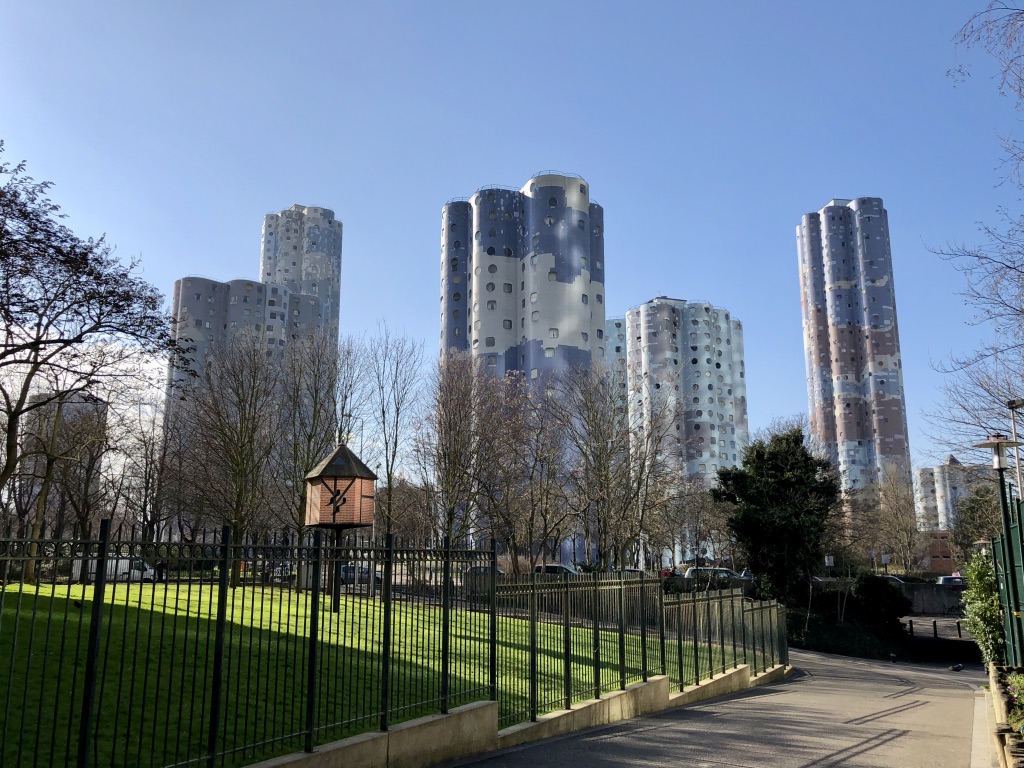
Built between 1972 and 1981 and named after their chief architect, Emile Aillaud, the Tours Aillaud comprise 18 towers housing 1,607 apartments. The towers are of varying heights with the smallest comprising 13 floors and the tallest 39 floors reaching a height of 344 feet.
Belying the notion that suburban social housing could only offer residents shoe-box style apartments, the Tours Aillaud resist straight lines and regularities with a series of connected cylinders, woven together by a labyrinth of passages, alleys, terraces and an undulating paved landscape.
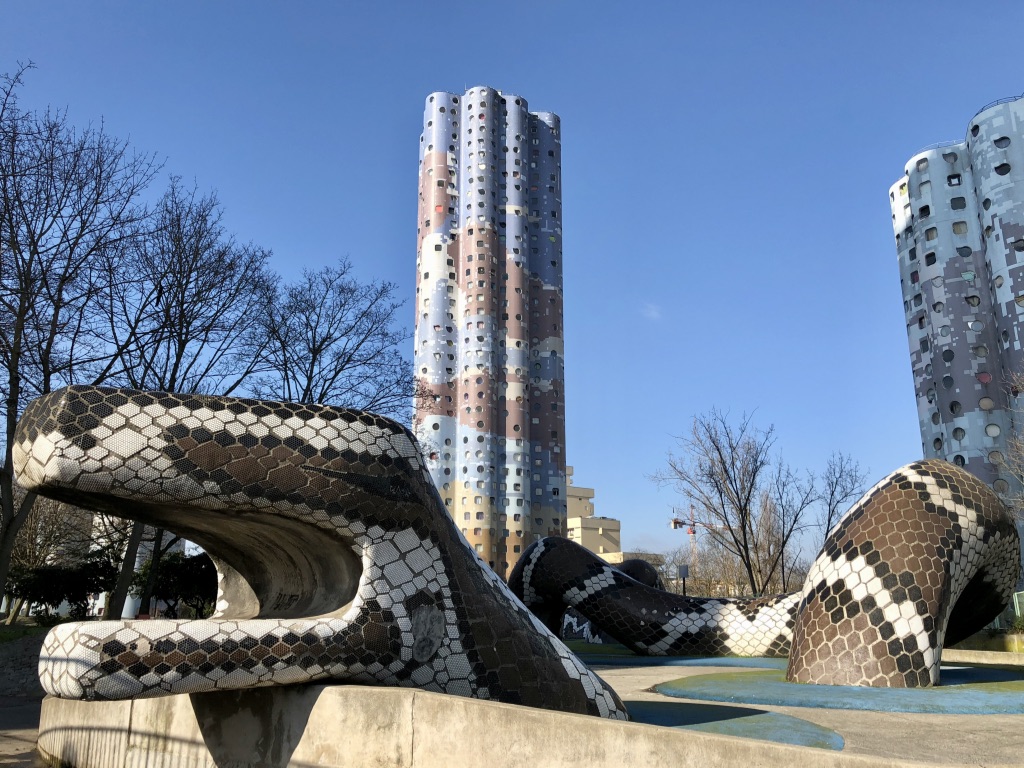
The cladding of each building is made of frescos in ‘pate de verre’ (paste glass) representing clouds in the sky. The French word for ‘clouds’ is ‘nuages’ so the Tours Aillaud are often referred to as the Tours Nuages.
The Tours Aillaud is somewhat of a family affair. Not only was Emile Aillaud the chief architect of the development but his daughter, Laurence Rieti, designed the large snake sculpture that forms part of the playground area near the highest towers and his son-in-law, Fabio Rieti, designed the pate de verre frescos on each building.

As well a designing the towers, Emile Aillaud also incorporated into the surrounding area one tree for each apartment, so over 1,600 trees.

Sounds around the Tours Aillaud:

Sadly, for the most part the post war Grands Ensembles didn’t live up to their utopian ideals as poverty and crime crept in and by the mid 1970s no more were being commissioned. Now, many have been demolished and more are due to be torn down as they age.
While the Tours Aillaud have survived, a confluence of events means that the prospect of change is looming.
It currently costs between €500,000 and €800,000 per year to maintain the buildings. Water seepage through the concrete walls and through the uniquely shaped windows is a persistent cost as is the maintenance of the pate de verre frescos. As the buildings age the maintenance costs increase.
The soaring maintenance costs are one threat to the Tours Aillaud, but another threat comes from the ultra-modern glass and steel corporate headquarters in neighbouring La Défense. The successful La Défense business district needs to expand and to do that it needs to engulf more of the neighbouring suburbs – Courbevoie, Puteaux and Nanterre. The Tours Aillaud in Nanterre are a prime target for this expansion.

Faced with the escalating maintenance costs on the one hand and the La Défense opportunity as they would no doubt see it on the other, the Nanterre local authority and the Département of Hauts-de-Seine have hatched a restructuring plan for the Tours Aillaud.
Although the plan hasn’t yet been finalised, several teams of architects and urban planners are working on the options for the site and they are in consultation with the residents. It seems clear though that the finished plan will include the demolition of some of the existing towers and the relocation of between one third and half the 4,500 people who live there. Some of the remaining towers would be converted to offices, co-working spaces and a hotel while the towers left as social housing would be refurbished and the outside walls reclad with more cost effective materials.
The consultation period runs until October this year and the work is due to begin some time in 2020.
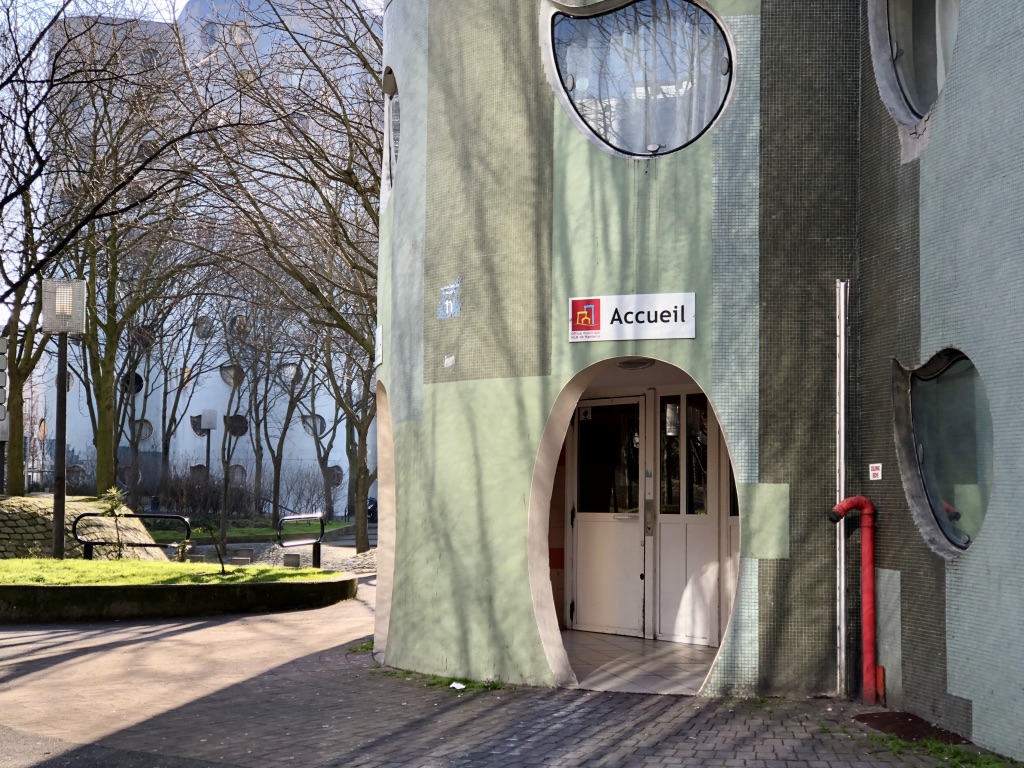
What will become of the Tours Aillaud remains to be seen. Consultation periods in France have a habit of overrunning their original deadline by some distance and projects regularly get mired in beaureaucratic red tape. But no doubt change will come at some point. In addition to seeing how the visual landscape of the Tours Aillaud changes I shall be particularly interested in monitoring how the soundscape changes.

Swing Jazz and a Fluttering Bird
IT’S THAT TIME OF YEAR AGAIN, the Christmas market season, and yesterday, on a very chilly Saturday, the Christmas market at the bottom of my little street opened for business.
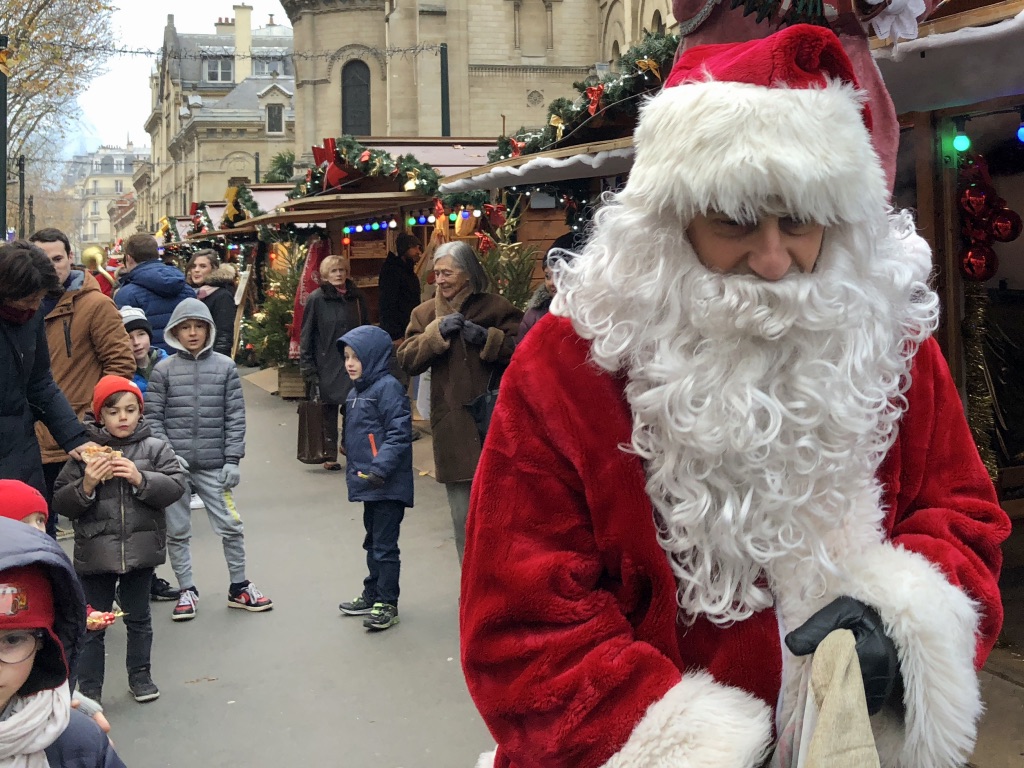
Twenty-eight wooden chalets bedecked with local and regional artisanal products stretch from the parvis of the Hôtel de Ville to the local church. Small it may be but it’s an intimate and friendly local Christmas market.
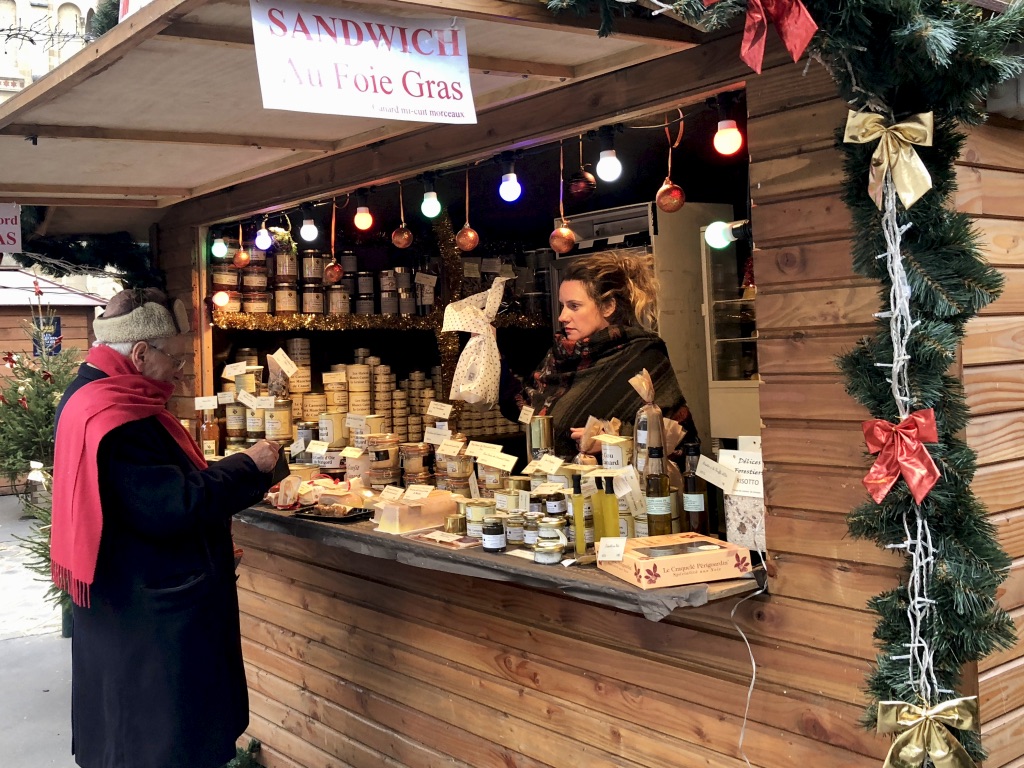
Amidst its wooden chalets, and the ever-present Père Noël, the market also boasts a variety of street entertainers, always a great attraction to both children and adults alike.
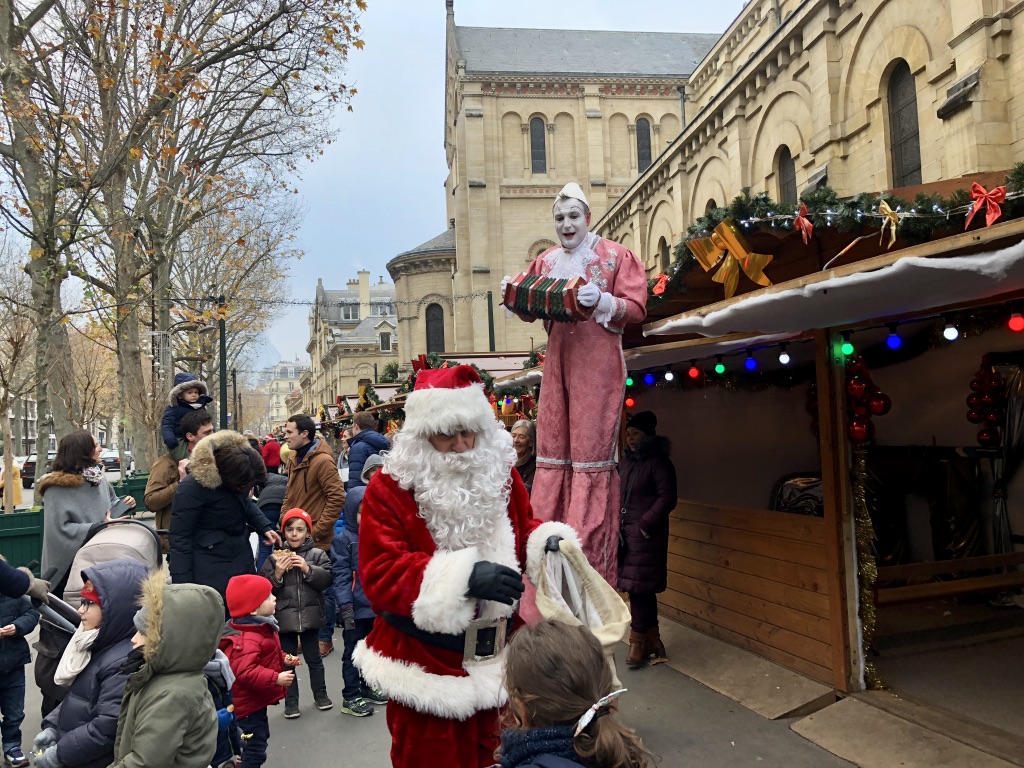
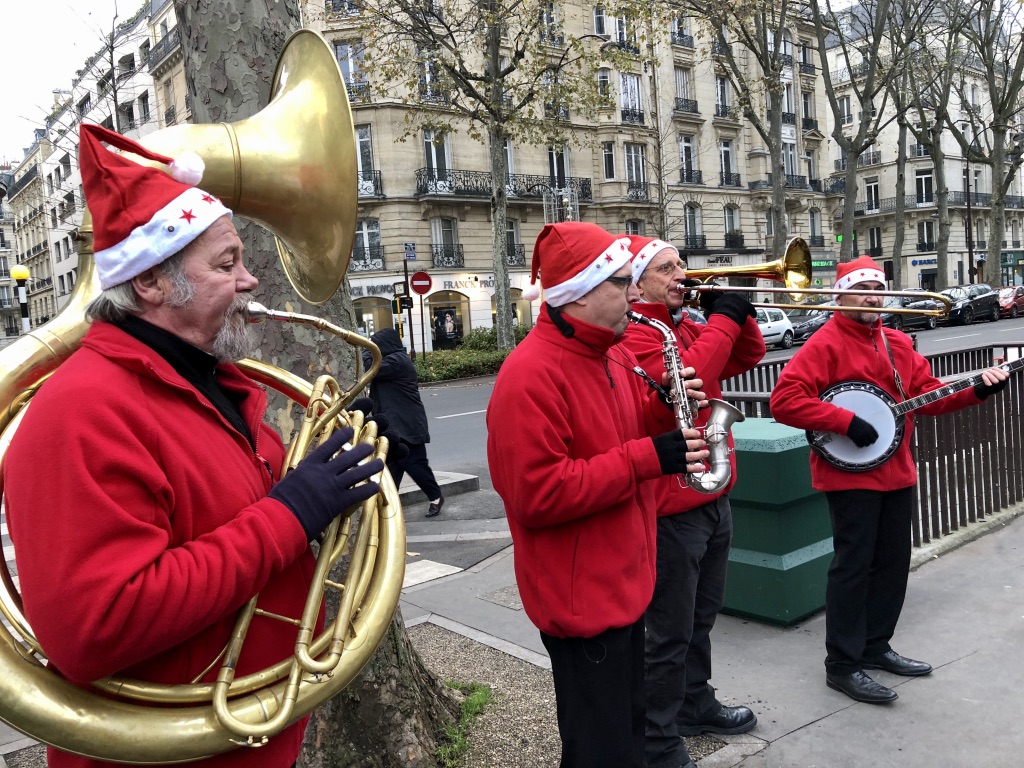
Yesterday, the street entertainment included a swing jazz band, Le Quartet Swing Connection, along with Lombardi, a concertina-playing clown on stilts.
I went along to the market yesterday to look at the stalls but also to record the street entertainers to add to my collection of Parisian Christmas Market sounds. As well as capturing the sounds of the jazz quartet I was also lucky enough to capture Lombardi the clown singing to the children.

Swing jazz and a fluttering bird:
Lombardi’s song was À la volette, a traditional French children’s song that first appeared in the mid-seventeenth century.
The song is about a little bird that takes flight and flutters its way to an orange tree (referring to a bird, À la volette means to flutter, or to flap). The bird lands on a branch in the orange tree, which breaks and the bird falls to the ground breaking its wing and injuring its foot. When asked if he can look after himself the bird says that he just wants to heal himself and flutter back to the orange tree and get married.
There are various versions of the song and yesterday Lombardi gave a slightly truncated version although the story is quite clear.

After the song, Lombardi teases out from the children the name of the instrument he’s playing: a con – cer – ti – na!
And, of course, let’s not forget Le Swing Connection and their afternoon playing swing jazz.
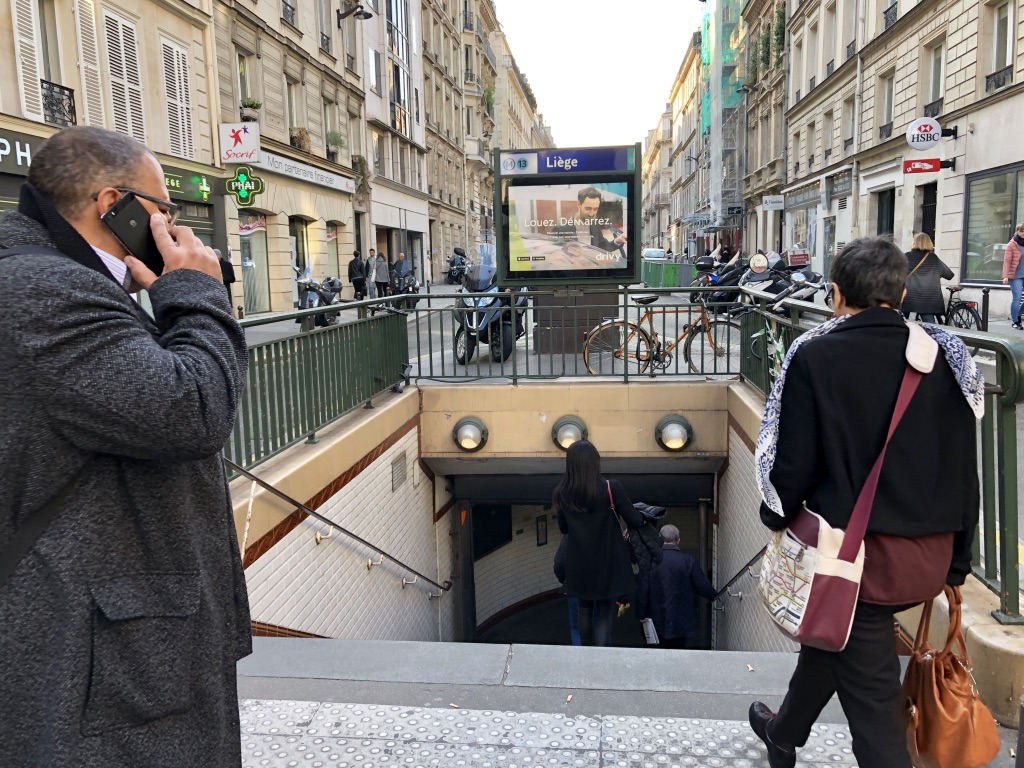
Métro Station Liège and its Sounds
YOU CAN SEE THEM clearly from the train but since the automatic platform doors have been installed it’s now more difficult to view them from the platform, which is a shame because the decorative ceramic panels on the walls add a touch of class to Liège métro station.
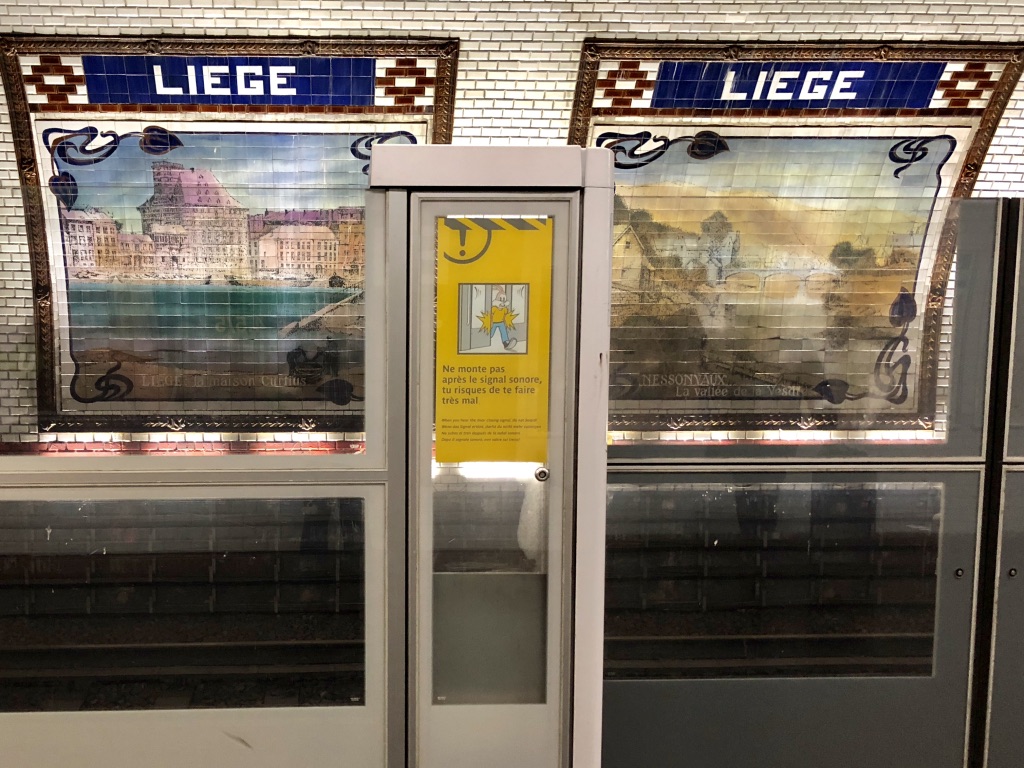
Created by two Liège artists, Marie-Claire Van Vuchelen and Daniel Hicter, and installed in 1982, the ceramic panels depict some of the landscapes and monuments of the Province of Liège giving a very Belgian feel to this Paris métro station.
What is now métro station Liège was opened originally as métro station Berlin on 26th February 1911 as part of the Nord-Sud Company’s Line B from Saint-Lazare to Porte de Saint-Ouen.
Paris métro stations are usually named after people, places or events so the station took its original name from the rue de Berlin, one of the streets radiating out from the nearby Place de Europe in the 8th arrondissement. When the First World War broke out in 1914 and anti-German sentiment was particularly strong, the name of the street and consequently the name of the station was changed from Berlin, the capital of France’s enemy, to Liège, a city in the friendly neighbouring country of Belgium.
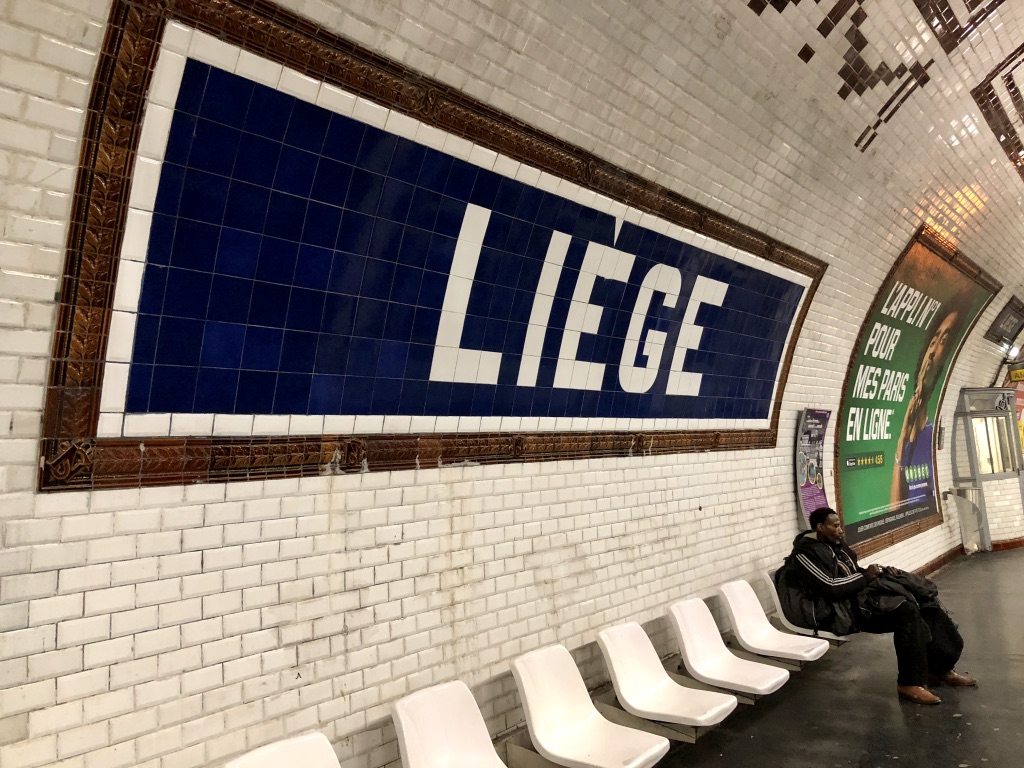
The ceramic panels are not the only unusual feature of this station.
As part of today’s Métro Line 13, the métro station Liège is located at the junction of the 8th and 9th arrondissements, about three hundred metres north of the mainline railway station, Gare Saint-Lazare. At this point, Line 13 runs directly under the rather narrow rue d’Amsterdam where it bisects rue de Liège.
This part of Line 13 was built using the ‘cut-and-cover’ method of construction. ‘Cut-and-cover’ is a simple method of construction for shallow tunnels where a trench is excavated and roofed over with an overhead support system strong enough to carry the load of what is to be built above the tunnel. The trench for this section of Line 13 was cut down from rue d’Amsterdam and because the street above was narrow so was trench forming the tunnel below. This meant that there was not enough room in the station to accommodate the usual two lines and two platforms opposite each other as is common in most Paris métro stations. Consequently, Liège is only one of two Paris métro stations to have offset platforms.

This rather poor picture culled from Wikipedia shows the offset platforms before the automatic platform doors were installed and it was still possible to see them.
The platform heading south (towards Châtillon – Montrouge) is located north of the junction of rue de Liège and rue d’Amsterdam above while the northbound platform (towards Asnières and Saint-Denis) is to the south of the junction. In each direction of travel, the trains stop at the first platform encountered.
This offset platform arrangement gives rise to a sonic curiosity. You can see from the picture that while the platforms are offset, both the northbound and the southbound tracks pass each platform. This means that this is the only station on the Paris Métro network where it is possible to hear trains regularly passing the platform without stopping. For example, if one is waiting at the northbound platform, the southbound train will pass without stopping and vice versa.

Stopping and passing trains in métro station Liège:
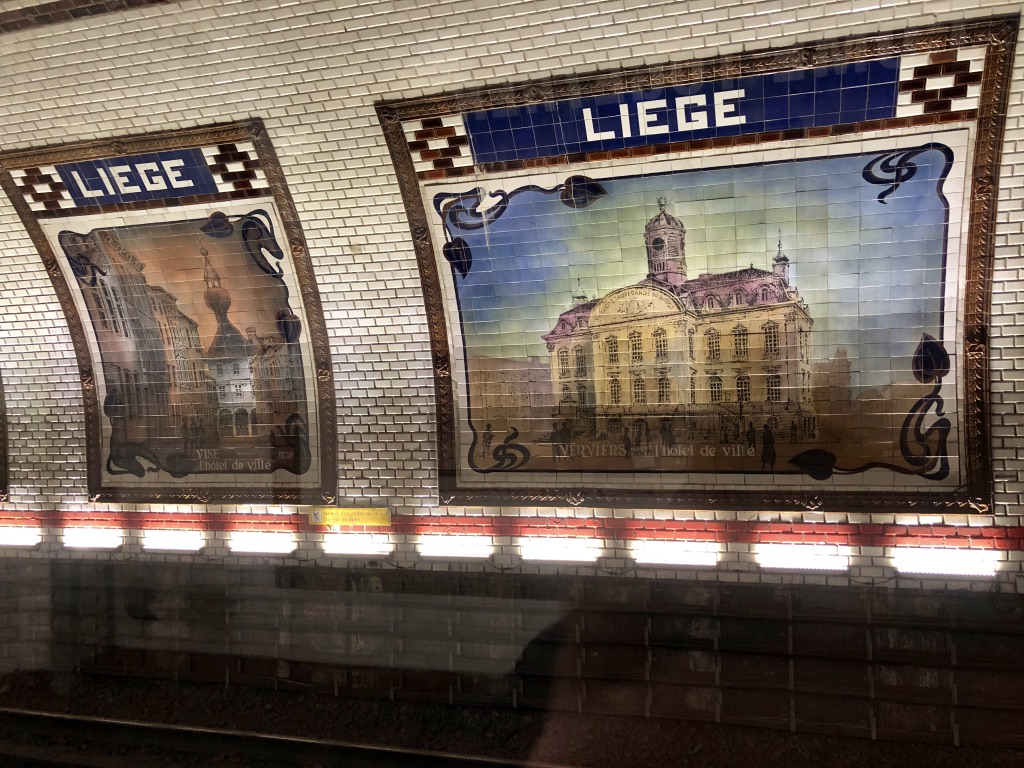
Another interesting sonic feature inside this station is the effect of the relatively narrow tunnel and its curved wall. The wall seems to both amplify the sounds of the trains while attenuating the ambient sounds between trains.
Note: I took these two pictures of the ceramic panels with my iPhone pressed against the glass of the closed automatic platform doors fully aware that at any moment what might seem like my suspicious behaviour could result in unpleasant consequences!
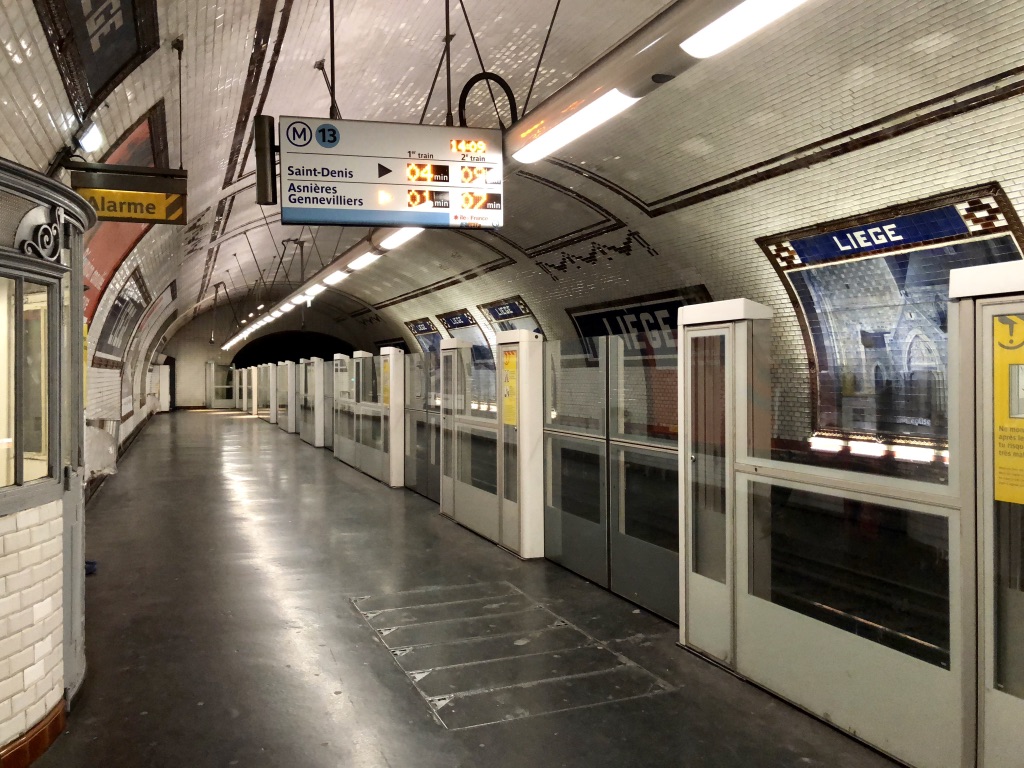
At the outbreak of World War Two, métro station Liège, like several other Paris métro stations, was closed for economy reasons. After the conflict, most of the stations reopened but some of them, including Liège, didn’t and they became known as the stations fantômes, or ghost stations. Liège station eventually reopened in 1968 but only with a limited service and it wasn’t until as late as December 2006 that the station began to operate a full service.
One of the features of Liège métro station is the platform office to be found on each platform. I have visions of them once being occupied by an authoritarian early twentieth-century stationmaster or maybe an equally authoritarian ticket collector. In fact, they date from the twenty-first century renovation of the station.

Of all the features of this station though it is the decorative ceramic panels made up of 6,576 ceramic tiles that dominate. There are eighteen panels altogether, nine on each platform.
On one platform are those designed by Daniel Hicter, each of which has a blue tone:
– Coo, dans la vallée de l’Amblève
– Les premières neiges en Fagnes
– Le barrage de La Gileppe
– L’Eglise romane de Momalle
– Le village de Limbourg
– Le château de Jehay-Bodegnée
– Le circuit automobile de Spa-Francorchamps
– Le château de Chokier-sur-Meuse
– Le Palais des Princes-Evêques de Liège
And on the other platform are those by Marie-Claire Van Vuchelen, each with a brown-ochre tone:
– La vallée du Hoyoux à Modave
– La vallée de la Vesdre à Nessonvaux
– Le Château de Wégimont à Soumagne
– Le Perron de Liège
– L’Hôtel de Ville de Verviers
– Le pont, la collégiale et la citadelle de Huy
– La maison Curtius à Liège
– Le Château de Colonster dans la Vallée de l’Ourthe
– L’Hôtel de Ville de Visé
If you’re travelling on Line 13 of the Paris Métro, it’s well worth getting off at Liège to have a look at these ceramic panels – even if you do now have to peer through the glass panels of the automatic platform doors.


 Soundlandscapes' Blog